Thursday, 16 May 2013

Delaware 2013, Part 1 - a.k.a. the not a lot of knot yet post!!!

It is hard to believe that a year has passed since I was in Delaware. This year’s trip seemed to creep up on me a little and it was almost a surprise when, last Friday, I found myself heading to Nigel and Jacquie’s in Norfolk to link up with them for the trip to the States. After a lovely evening admiring their beautiful house and garden, I went to bed listening to starlings scrabbling around in the roof and by 7am on Saturday we were on route to Heathrow Terminal 1. 

The flight was uneventful, if slightly bumpy at times, with the highlight being the chance to see The Hobbit, which I had missed at the cinema. Before we knew it, we were landing and Nigel, Jacquie, Richard, Graham and I headed to the immigration desk. As we were waiting, we spotted Guy’s BA flight landing and were optimistic that we would all get through nice and quickly and soon be heading to Slaughter Beach. We started to get a little worried when the line of people coming off the BA flight reduced to a trickle with no sign of Guy. Eventually, he appeared and joined the back of a now very long line of foreigners waiting to be let into the country. We waved from the front of the queue and left him to it as we went to re-acquaint ourselves with our luggage. 

A few minutes later and we were through customs and saying hello to Rob and Kevin in the arrivals hall. ‘Guy won’t be long’ we assured them. Wrong! An hour later, we were beginning to wonder whether Guy had been invited for a behind the scenes tour of the immigration suites as he still hadn’t appeared. Thankfully, he turned up eventually and off we went. 

Saturday evening (US time – middle of the night UK time) was spent meeting the American volunteers and settling in. The warm and humid evening saw me set up my little sleeping space next to a window which was thrown open wide to cope with the heat. After dinner, Kevin informed us that there weren’t very many target species (knot, turnstone, sanderling) around as yet and there were peregrines causing havoc in Mispillion Harbour but that the following day we were going to try for a catch on Back Beach.  

The open window came back to haunt me at first light on Sunday as I was woken by the sound of hundreds of laughing gulls (who really do live up to their name), dozens of purple martins and a mourning dove. There are worse ways to be woken! When everyone else was also awake (at a slightly more civilised hour) we set out for Mispillion Harbour. A small group went out first to set the net and wait on the island whilst ‘basecamp’ followed on and sat anchored in the boat just off the island waiting for the action.
 
Back Beach, Mispillion Harbour at dawn

We waited and whilst we did, we were treated to the site of fourteen turkey vultures (the American equivalent of our buzzard) congregating on the marsh to feed on something. We really wanted to go and find out what it was but weren’t able to. The local osprey weren’t too impressed by their presence! At this point, the most numerous birds on the island were laughing gull. We were slightly lacking in shorebirds. Jacquie took the opportunity to do some work, holding on very tightly to her papers in the wind, whilst the rest of us chatted and enjoyed the view. As the wind strength grew, so did the number of layers we were all wearing. Unfortunately the number of shorebirds didn’t! Basecamp took a trip around the harbour looking to see if there were any birds to move into the catching area. The pilings in the harbour mouth were full of turnstone and sanderling but they didn’t want to be moved so we called it a day and headed back to the house. 

The afternoon was spent visiting other beaches in the area to do counts of what birds were around and look for leg flags. I took the opportunity to visit Prime Hook beaches, which I hadn’t been to last year. The wind was by now making walking difficult; keeping a scope still was almost impossible. The birds were all hunkered down off the beach making leg flag re-sighting impossible. There was however, a seriously impressive number of black-bellied plovers (grey plover) with the count heading towards 600 birds, most of which were heading towards full breeding plumage – mint! 

With few birds still in the harbour, Monday morning saw us heading down to Port Mahon to try to catch turnstone. The rocky shores along this stretch have been made even rockier by works to protect the road, with the result that there is virtually only one place left to try to cannon net. With the tide rising, we quickly set a net and Graham and I, with Guy driving the Jeep alongside us ready to race quickly back to the catch, walked the rocky shore in an attempt to persuade the turnstone to head towards the catching area. It didn’t take long for birds to be catchable and suddenly, Richard came over the radio shouting ‘Kevin has fired, Kevin has fired’. The first catch of the season resulted in twenty-two new turnstone being ringed and flagged. 

On Tuesday morning, a group of us headed out at dawn to check whether there had been a knot influx into Mispillion Harbour overnight. Sadly there hadn’t been but we were treated to a beautiful morning with gorgeous light and fabulous views of the ospreys nesting in the Nature Centre car park. On the way back to the house we stopped to coo over the killdeer and her four tiny little chicks that are dicing with death next to the road and I then saw my first new species of the trip – cliff swallow. It was very helpfully sitting next to a tree swallow which was useful for identification purposes. 


Osprey in the Nature Centre car park

Dowitchers and least sandpipers along the road to Mispillion Harbour
Killdeer with one of its four chicks
Cliff swallow (left) and tree swallow (right)

Cliff swallow

Tree swallow

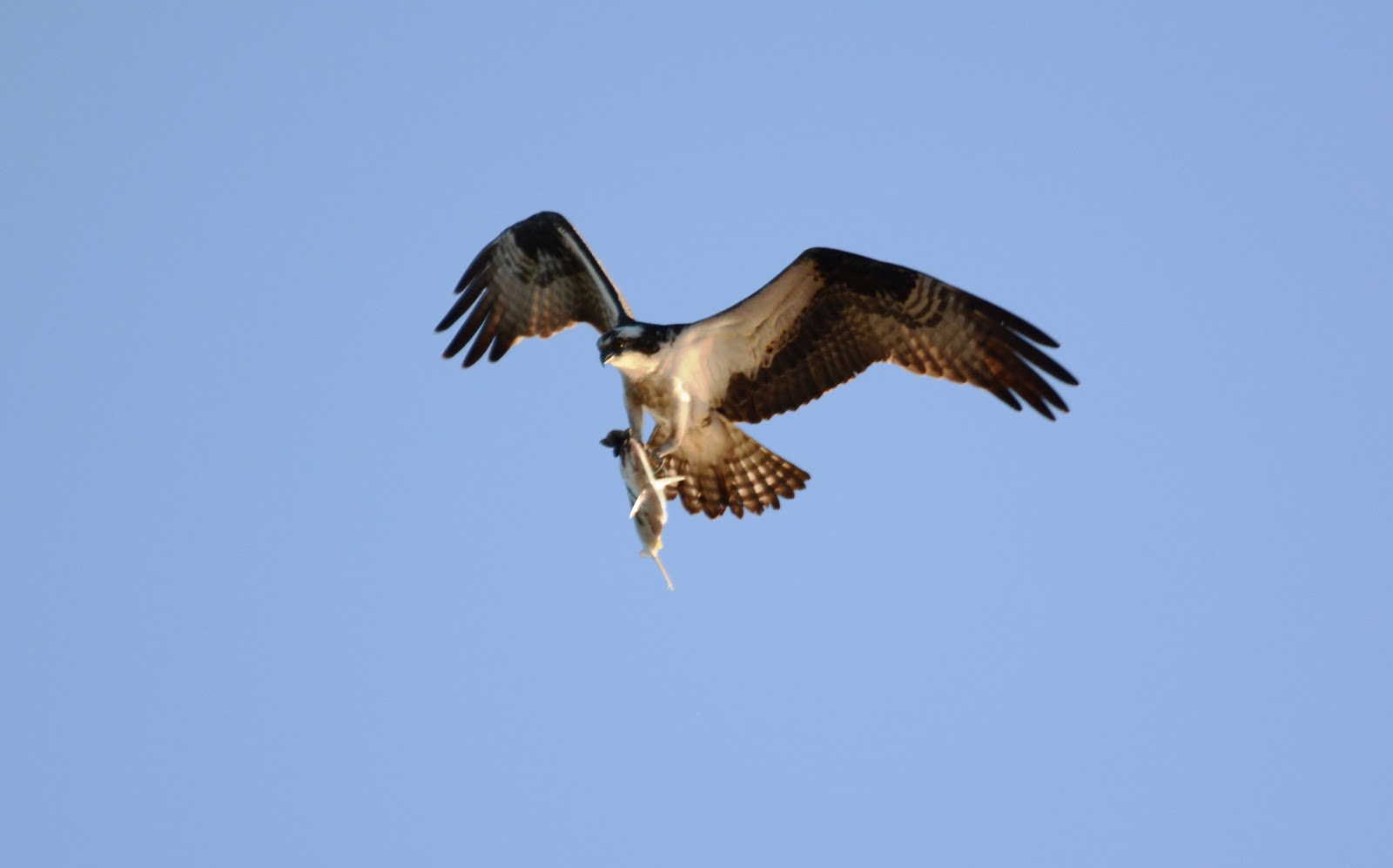
Back at house we re-grouped and most of us headed back to Port Mahon to try for another turnstone catch. This time, we left a little earlier and had time to set two nets. After twinkling the length of the shore twice, enough birds decided to play ball and we fired both nets on a nice catch of thirty-nine turnstone, four least sandpipers, five semipalmated sandpipers and a willet. I was lucky enough to ring virtually the entire catch, which included two new species for me (least sandpiper and willet). I was also lucky enough to get another great sighting of an osprey with a fish.


Willet

Least sandpiper
Osprey with fish
Later that afternoon, my hoovering and cooking duties were diverted elsewhere and I was lucky enough to get to go on a boat trip out into Delaware Bay to look for birds using the beaches along the Bay (that take a long time to walk to). I wasn’t entirely prepared for what happened when we passed outside of the no wake zone. Kevin asked whether we were ready and then put his foot down (or whatever the boating equivalent of this is!). The word exhilarating only just covers it! Even getting a face full of spray on numerous occasions was worth it for the thrill! Unfortunately though, there were no more birds on these beaches than in the harbour! On the way back to the harbour, Nigel suddenly exclaimed that he might just have seen a dolphin or a shark. Kevin slowed the boat and we were treated to twenty minutes of dolphin after dolphin swimming past. One even delighted us by jumping out of the water really close to the boat. None of us are cetacean experts but we decided that they had to be Atlantic Bottlenose given that they are the only species known to be in Delaware Bay! 

Wednesday was a more sedate day. After another early morning recce to Mispillion Harbour to look for the (still absent) knot, I spent the morning on Slaughter Beach taking photos. I spent the rest of the morning and early afternoon at the house. Mid-morning, I nipped out onto the balcony where my bright pink jumper attracted the attention of a cracking male ruby-throated hummingbird who flew within a foot of me, buzzing and chattering – magic! 

Horseshoe crabs on Slaughter Beach
A pair of horseshoe crabs (female at front, male hooked onto heer back)
It's a crab eat crab world!


Dunlin
Semis
Mockingbird sitting on a horseshoe crab

Later in the afternoon and I was on the boat heading out to try to re-sight colour rings on Back Beach. The trip proved to be somewhat futile due to a low flying air force plane and the two peregrine fly pasts! Only one knot flag was read, but at least there were a few there (about 50). Frustratingly a couple of other flags were seen but the birds were so flighty that they flew before they could be read. There may not have been many birds out there, but I did have two lifers in caspian tern and fourteen glossy ibis in full summer plumage. 

We are hoping that tomorrow will be the day and the early morning recce to Mispillion Harbour will find thousands of knot waiting to be adorned with flags… well, we have to dream don’t we?

Sunday, 5 May 2013

More sleep deprivation... and a hail storm!

Another weekend, another visit to Norfolk to ring with the Wash Wader Ringing Group. The team met on Friday evening and found the times for the evening and morning’s activities written on the board. ‘Umm, are those timings correct?’ was heard to be uttered a number of times before Nigel returned from his recce of Terrington Marsh to confirm that they were indeed accurate. In fact, they weren’t… instead of having the three and a half hours sleep that the board suggested we would get, we actually only got around two hours!!! 

Aron’s recce on Friday morning had found a good collection of grey waders (knot, grey plover, sanderling, dunlin etc.) on Snettisham Beach so, on Friday evening, we set three nets in anticipation of the morning tide. Unfortunately, the birds had other ideas and found themselves a better place to be on Saturday morning. Just as we were beginning to get disconsolate, a flock of ringed plover appeared in the catching area. We were able to take a small (but useful, as we don’t ring huge numbers of ringed plover) catch of eighteen ringed plover and three turnstone. I was part of the processing team for the catch but did manage to ring one bird which was a treat as I have only ever handled one ringed plover before. The processing team had to de-camp into the back of Aron’s car when a hail storm made ringing in the open problematic – not what we expect in Norfolk at the end of April! 

After breakfast, the team all headed back to bed for a couple of hours of well needed sleep. Refreshed and ready to go again, we headed to Heacham Beach in the afternoon to set two nets for an evening catch of oystercatchers. A nice catch was made of 56 birds, including a 21 year old retrap! I was in the processing team again, but thankfully, no hail storms interrupted us this time. 

After an early night some members of the group went out colour ring re-sighting on Sunday morning, whilst the crocks amongst us (me included) stayed behind and did jobs around the base. When all were back, the group held its AGM before everyone headed home for another early night!

Cormorants and herons

A couple of weekends ago I joined Jim, Gary and Mick at Attenborough Nature Reserve to (hopefully) ring cormorant and heron pulli. It was a gorgeous morning and as we met, the nature centre car park was filling up fast with visitors eager to enjoy the long awaited sunshine. Rob (who works at Attenborough) soon arrived and he and Mick headed off to collect the boat. A few minutes later and we were life jacketed up and chugging out to one of the many islands on the reserve.
 
Cormorant nests on one of Attenborough's many islands
As we neared, we assessed the age of the birds we could see on nests to ensure that none of them were old enough to be likely to try to leave their nests in our presence. Thankfully, they were all small enough to ring safely so we landed at the end of the island and Mick got to work with his climbing gear. Pretty soon, he was up the tree and lowering the chicks down to us. As we ringed the chicks, Mick added a number to each nest to allow us to monitor the nests more easily in future.
 
Mick climbing up to the nests
 
Cormorant nest number
The chicks were ringed with both a metal ring and a darvic (colour ring) so that they can be monitored without needing to be recaptured. First nest done, we moved along the island a little, numbering nests as we went. We ringed a second brood of chicks under the watchful eye of another of the island’s inhabitants.
 
Canada goose watching us ringing cormorants
 
Me with a cormorant chick
Cormorant chick with darvic
After ringing two broods, we left the island, as we didn’t want to keep the adults off the nests for too long, and went to check on a heron nest whose chicks had been too young to ring on the previous visit. The chicks were now a perfect size and we were able to add metal rings and colour rings to these birds too. With the pulli ringed and safely back in the nest, we headed back to the nature centre. The wind had picked up to levels that were both unsafe to climb in and too cold for adult birds to be off chicks for long so we called it a day.
 
Mick with a heron pullus ringed and ready to go back in the nest
Hopefully, data gathered from future sightings of the colour ringed herons and cormorants will provide currently unknown information such as whether they nest in the same nest each year, whether chicks return to their natal site to breed, longevity and so on. Attenborough Nature Reserve is a very heavily visited reserve so hopefully, lots of re-sightings will be reported for these birds. It will be fascinating to see what can be learned in the years to come.
 
Thanks to Gary for the cormorant pictures.

Thursday, 4 April 2013

Easter Weekend...Part 3 - Who Needs Sleep?

So, the ‘somewhere else I needed to be’ that prevented me from staying in Norfolk on Sunday evening was Brackenhurst on Monday morning. At 6am, I joined Jim, Gary, Duncan and Emma for a morning’s ringing at one of our winter feeding sites. It was a bitterly cold morning that should have yielded good numbers of birds in the nets. Unfortunately, this wasn’t to be.

The morning started auspiciously enough when a woodcock flushed from one of the rides that we were setting nets in. Despite Jim and Gary’s best efforts during the morning, it didn’t want to play and refused to be flushed into the nets. The net rounds started slowly with just a few birds each time and to be honest, they didn’t get much better. There just didn’t seem to be many birds around.

The highlight of the day for me was a goldcrest. They are stunningly beautiful little birds and I haven’t seen one in the hand for a while, so it was a treat to get to ring that. A re-trap tree sparrow was also nice to see. The first of this year’s migrants paid us a visit – one chiffchaff who responded remarkably quickly to the sound lure. Interestingly, most of the re-traps that we caught were adults, heightening our suspicions that last year was a disastrous breeding season. A lot of the chaffinches we caught also had high fat scores indicating that they may be continental birds that haven’t yet set off on the return journey to their breeding grounds.
 
Gorgeous little goldcrest
First spring migrant of the year
We gave up late in the morning when the winds became too strong and we could no longer feel our fingers! Twas a nice morning, despite the cold and the low avian turnout!  

Oh and in answer to the question in the title, by the end of the weekend, I did!!!

Wednesday, 3 April 2013

Easter Weekend...Part 2 - Ringing on the Wash

With my WeBS counts done, it was now time to head over to Norfolk to join the Wash Wader Ringing Group for a weekend’s ringing. Arriving on Friday evening, it soon became clear that it was going to be a long night! With the equipment sorted, introductions done, a lovely tea eaten and the tide receding, we headed out at 9pm to set nets for an attempted cannon net catch on Saturday morning. The Friday morning recces had found approximately 20 000 knot on Snettisham Beach so hopes were high for a good catch. 

As the team started to set the nets under a cold, starry sky, the moon rose big and beautiful over Ken Hill behind us. The tide was still receding and as the cannon net holes were dug, they soon began to fill with water, preventing us from filling them in. Still, there are plenty of other things to do when setting cannon nets so by the time we had finished, the water was low enough to fill the holes without the risk of the cartridges getting soggy!

By the time we got to bed it was half past midnight, which in and of itself, isn’t too bad. However, when you factor in the fact that the alarms were set for a quarter to four the following morning, it was a tad evil!!! So, a very small amount of sleep later saw us heading back to Snettisham and by just after 5am we were shivering at base camp. The briefing had suggested that if we hadn’t caught by 6am, we would be rushing to lift the nets out of the way of the rising tide. We therefore did what we always do…we waited.
 
Nigel kept base camp informed over the radio and soon reported that we had 100+ knot in the catching area. With plenty more on the mudflats, hopes were high. Not long after, all the knot headed to the Pits! Luckily, a flock of oystercatcher turned up and Nigel gave the order to arm the box. Cue the adrenalin. It’s a strange thing how the adrenalin starts pumping and at the same time, the nerves start to kick in when you hear the words ‘arm the box’, even though there is still a chance that the words three, two, one, fire won’t follow!

Thankfully, those words were uttered on Saturday morning and we were able to make a nice catch of 50+ oystercatcher, 3 bar-tailed godwits and 4 common gull. When the question ‘who hasn’t ringed a common gull?’ was asked, my hand went sky high and I was lucky enough to get to ring a new species (and without getting bitten which was a bonus). The rest of the catch was spent scribing for the processing team.

The bonus of an early catch is an early breakfast. After that, it was time to do a few jobs back at base before most of the team headed out to set mist nets on Terrington Marsh for the evening tide. The tide was due to be pretty high that evening so we were all prepared to be wading quite deeply during the catch. I have never been on the marsh after dark when it has covered completely so it was an interesting experience…particularly when the high water level means you cannot see the creeks that you usually use to navigate your way off said marsh! We did eventually make it back to base, but not without a little help from our friends on dry land and some bright torches!

Anyway, a small catch of dunlin, a few redshank and a solitary knot were caught mist netting. Sometimes it is nice to get relatively small catches, particularly when the team includes a lot of people new to wader ringing, as this weekend’s team did. A small catch allows the ringers chance to get to grips with the ageing criteria of the species in the hand without the pressure of having to get through hundreds of birds quickly.
 
This weekend’s team also included Rick and Ellis from an organisation called Wader Quest. They were there to document the work of the group for their project. The small, more relaxed catches also allowed them to get involved and to get some great photos. More information on Wader Quest and some of their photos from the weekend can be found on their website http://www.waderquest.org/.

So, the day finished at about 12:30am again and we all went to bed in the hope of getting a good six hours sleep before heading out to do some colour ring re-sighting on Sunday morning. Whenever a Wash weekend falls on the same weekend that the clocks change, it is traditional not to alter the time zone until the end of the weekend, so as not to confuse things. Unfortunately, nobody told that to our smart phones, all of which kindly changed the time automatically and woke us up an hour earlier than necessary…thanks for that!

I, along with three other members of the team, headed out to Holme to attempt to find some birds willing to show us their bling. It soon turned out to be a stunning morning with wall to wall sunshine. There were quite a few birds on the spits that don't cover at high tide (many of which were hiding on the far side, out of sight) but as the tide rose, more and more became visible. The rising tide also flushed out a water rail which we watched swimming between dry islands of vegetation! We eventually found a flock of sanderling that were close enough to scope up for rings and found three colour ringed birds. Unfortunately, none of the godwits or grey plovers in the same area was flagged.
 
Holme Beach on a gorgeous, sunny morning
Ringed plover - it just wouldn't play the game and face the
camera!
Some of the team stayed on in Norfolk on Sunday evening for another mist netting setting at Gedney, but I had somewhere else to be, so I headed home, tired but happy after another great weekend with my friends at the Wash.

Tuesday, 2 April 2013

Easter Weekend…Part 1 - WeBS

This weekend started with a trip over to Nottingham to do my WeBS counts (yes I know, slightly belatedly). It was that nice a morning, I didn’t even need to wear a woolly hat! I arrived at Martin’s Pond in Wollaton slightly ahead of my friend and fellow WeBS counter, Mike, so I headed onto the site to wait for him and to play with my camera. I was duly greeted by a pair of swans who waddled over and proceeded to try to eat my jacket! They soon realised it wasn’t very tasty and went in search of something a little more nutritious.

Tufted duck at Martin's Pond

Pochard at Martin's Pond
As Mike and I wandered round counting the water birds, the birds in the trees above us were singing their little hearts out. Here’s hoping they know something the weather forecasters don’t and that spring really is on the way. The walk through Harrison’s Plantation to Raleigh Pond took slightly longer than usual as we were distracted by siskin, nuthatch and coal tit (amongst others). It was nice to see a few shoveler on Raleigh Pond too – not a usual suspect there!

Siskin in Harrison's Plantation
Fluffed up siskin - maybe the birds still
think it is pretty cold!
On to Wollaton Park… Now, I know that Attenborough likes to play host to all sorts of not exactly native species, but Wollaton Park was joining in the fun on Friday with a pair of Egyptian geese to go with the red-crested pochards and the ubiquitous Canada geese. They really are funny looking things! The lake had an unusually high number of swans on there too, but sadly, none of them were anything other than mutes. The recently formed heronry is up and running again this year with four birds sitting on nests (and a number of other seemingly empty nests in close proximity). One of the many Canada geese kindly showed off its colour ring to me, which was nice of it, and it appeared to be a bird I had not seen there before (at least I didn’t recognise the ring number, although I may yet be reminded that I have indeed seen it previously!).

On the way back around the lake we were treated to a very close view of a treecreeper, one of my favourite little birds! All in all, a very nice morning. Good to catch up with Mike, see some sunshine and have decent numbers of birds to count.

Monday, 25 February 2013

Sunday at Granby

So, after being ill for the first few weeks of the year, it was a delight to finally be able to get out ringing again this weekend. I joined Jim, Duncan, Emma and Dave at Granby for a chilly (well it wouldn’t be Granby if it wasn’t freezing) morning’s ringing at one of SNRG’s winter feeding sites.
 
It sounded pretty quiet as we were putting the nets up so we were not expecting a big catch. The first round provided about twenty birds which was a bonus. Subsequent rounds were steady, but provided fewer birds and we finished on seventy-four birds including a treecreeper, a brambling, a redwing, yellowhammers, great tits, blue tits, dunnocks, blackbirds, robins, chaffinches and a wren.
 
Oh and not forgetting my personal favourite, a very feisty, female green woodpecker. We had heard her laughing at us a few times during the morning from a little way off but hadn't seen her. Then all of sudden, Dave was up and running... He had seen a large bird flying into the net and thought it was a sparrowhawk, but when he got closer, it turned out to be this little beauty! This was a new species for me and I was lucky enough to be able to ring her. Her wing showed two different ages of feathers indicating that she had been born last year. It certainly made my morning!
 
Beautiful female green woodpecker
Green woodpecker wing showing two ages of feather
Thanks all for a great morning (and great to meet you Dave - thanks for running so quickly!).
 
Ruth