Thursday, 27 February 2014

Wind? What wind? Oh, that wind…

A week in advance of the trip, the forecast for the last Wash weekend was looking poor so it was no surprise to get an email from Jacquie on Friday morning telling us not to hurry to Norfolk as we would not be going out to set nets that evening. After an horrendously wet and windy drive, I joined the other hardy souls that had laughed in the face of the elements for a delicious Thai pumpkin soup and a relaxing evening.

Instead of trying to catch in 60mph+ winds on Saturday morning, we all headed to different beaches to do some colour ring re-sighting. I went to Snettisham Pits, interested to see how it was recovering from the December storms. The sight was a sad one, with three of the four hides destroyed and obvious devastation around the reserve. The winds were the strongest I think I have ever encountered and it was a real effort to walk down to the wader watch point. We soon retreated to the only hide still standing and tried to keep our scopes still enough to see some flags. Well, we did see flags but unfortunately, the birds were too far away to read them. It was fun watching the birds having as much trouble standing still as we were! The walk back to the car park was more of a trot at times as the wind pushed us along.

The afternoon was spent doing jobs around the house and doing some ‘gardening’ along the access route to Snettisham. That evening, the wind seemed to have dropped a little and we were finally able to think about doing some ringing. We set three large mesh nets on the beach at Heacham South with the hope of catching the oystercatchers and barwits that had been on the beach during the recent recces.

At 05:30am on Sunday we headed back to Heacham, settled in at base camp, listened to the sound of oystercatchers on the beach, watched the sunrise and the pink-footed geese flying around the fields behind the beach and crossed our fingers. The recent stormy weather affected the tide and caused it to make considerably, meaning it was too high up the beach before it was light enough to catch safely. Phil took the decision to wait for the falling tide but unfortunately the birds were jumpy and spooked out of the catching area. Despite valiant efforts to twinkle the other birds on the beach, it wasn’t to be and we were soon collecting in the unfired kit.

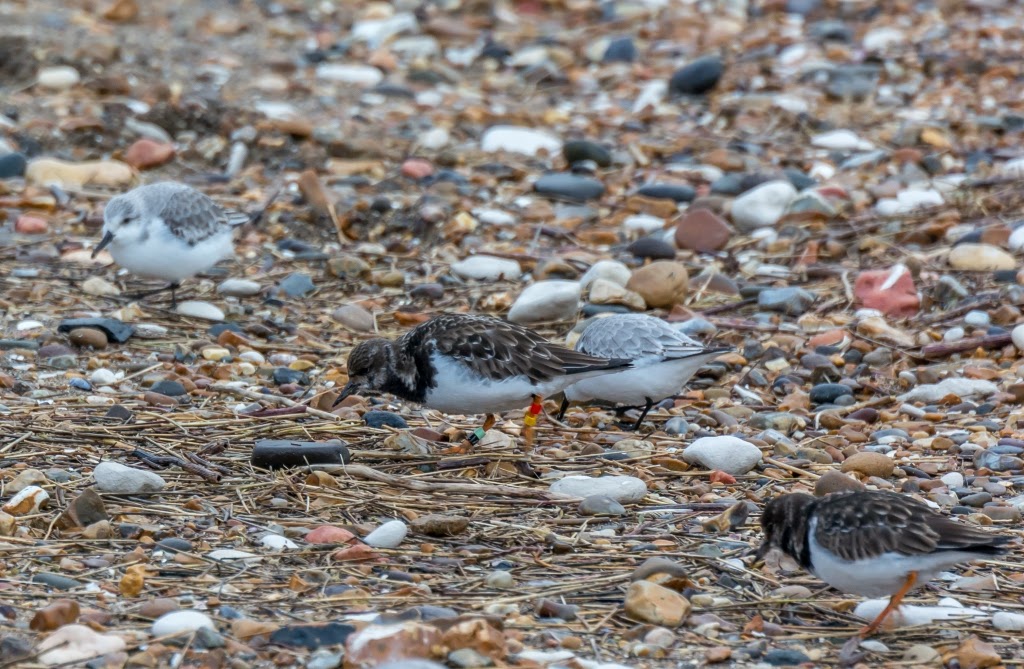
As it was such a beautiful morning, we decided to go colour ring re-sighting at Heacham North beach and were rewarded with a very high proportion of ringed birds. As I didn’t have a scope with me, I took full advantage of the gorgeous light to take a few photographs (okay, so I sat on the beach for an hour taking pic after pic after pic) including a few of ringed and colour ringed birds. The best shots can be seen on my photography website In Nature's Image

Colour ringed turnstone

One ringed knot in there
On Sunday evening a few members of the Group stayed on to try mist netting at Gedney. They were rewarded with six birds so the weekend wasn’t a complete blank on the bird front. Let’s hope the weather is a little more kind to us in March!

Thursday, 30 January 2014

Snow stops play

With a couple of days off work, I jumped at the chance of joining Jim, Duncan and Tom at the winter feeding site at Granby this morning. The site is affectionately known as the Granby Fridge Experience (for reasons that become painfully obvious to anyone who goes there) but for the most part, it didn't live up to its name today…that was until it started snowing!!!

The nets were up by about 07:30 and we feared a quiet morning as there had been little calling or flying along the former railway line as we set. The first round did nothing to dispel this fear as it returned only a few birds. The second round was better and this was the point at which our fingers started to disagree with the rest of us about the temperature.

As we finished processing the birds, a few flakes of snow started to fall. Hoping it was our imagination we carried on regardless. By the time we were extracting the birds on the third round, we were being covered by large snowflakes and we had no choice but to close the nets. The birds (in bags) took shelter in Jim’s landrover and we did our best to process them with painfully frozen fingers.

Snow soaked chair

Birds keeping dry in the landrover
We took the nets down at 10am and packed up. By the time everything was away, the snow had stopped and we were debating whether we had been too hasty to pack up but we decided to stick to our decision. The drive out of the site became a little eventful when the landrover decided to drive sideways instead of forwards! A little digging and a little pushing later and we were on the move again, just as it started raining.


Oops. It really shouldn't be at that angle!
Despite the shortness of the session, it was nice to be out at Granby again. We caught 30 birds of seven species, with the majority of individuals being great tits, blue tits or yellowhammers.

New website

The other reason for the lack of posts on here recently is that I have been busy with a new venture. As some of you may have guessed from this blog, I am quite keen on photography. After much procrastinating, I have finally got around to creating a photography website. The site will be showcasing my favourite photographs and (hopefully) will be updated on a regular basis. The site also contains a blog which, surprisingly, will be photography focused.

If you would like to take a look, please head over to www.innaturesimage.co.uk. Feel free to leave me a message in the guestbook!


Passerine ringing

I haven’t been passerine ringing for what seems like a very long time so it was with a little trepidation that I found myself driving out to Brackenhurst the other Sunday to join my friends in the South Notts Ringing Group. Thoughts such as ‘will I remember how to age a yellowhammer?’ were running through my head as I negotiated the A617. Luckily, it seems as though ringing is a bit like riding a bike; you soon remember how to do it once you get back on it.  

We met at a respectable 7am and set both the feeder nets and the nets in Orwin’s plantation. The sound lure in Orwin’s failed to attract much at all, except for one fieldfare, one goldcrest, one robin and possibly the odd tit (my shocking memory is why I should write these posts closer to the events!). Thankfully the feeder nets did much better, until the wind decided to come out to play that is! We packed up early, finishing on 56 birds which was approximately half the previous week’s tally, despite the weather apparently being very similar.

The totals included tree sparrows, yellowhammers and a greenfinch, the latter of which is a bit of a rarity round here these days! It is always lovely to see tree sparrow in the hand and it was good to refresh my memory on the intricacies of ageing yellowhammers. Unfortunately, the large flocks of thrushes that were teasing us by flying around the field all morning didn’t respond to the sound lure and neither did the green woodpeckers that were calling to each other throughout the session. Good job there is always a next time J

It felt really good to be ringing passerines again and it was great to catch up with some members of SNRG that I haven’t seen for a very long time!

First Wash of the year…

The last Wash trip of 2013 was in December and unfortunately, it clashed with the BTO Conference in Swanwick. I chose to attend the conference, which meant that I didn't get to catch any birds, but I did get to spend the weekend with a large number of the Wash regulars! It was a fantastic weekend with many interesting and informative talks.

Having not been ringing with WWRG since October, I was raring to go when the first Wash weekend of the year came in January. I arrived at the house on Friday evening just as Phil was heading out and round to Gedney to join the early birds who had been able to get there in time to go mist netting. I settled in, chatted to the few others who were there and waited for Nigel to arrive. When he did, it was all hands on deck to load the cannons and the trailer ready to set four nets at Snettisham Beach after high tide. After a warming bowl of soup, we trundled down to Snettisham to set four small mesh nets. We were met by the Gedney team who had managed to catch 38 birds. A great start to the weekend.

After an efficient net set, we headed home for a briefing and bed for a few short hours. Before we knew it, it was morning and we were heading back to Snettisham, keeping our fingers crossed that the sanderling that had been on the beach yesterday had decided to return. We snuggled down at base camp and waited for there to be enough light for Nigel to see the catching area. Luckily, the birds were there and after a little gentle twinkling they were in the right place and we were soon hurtling down the beach to the nets. We were delighted to find over 450 sanderlings in the net, including a huge number of re-traps. More great data! We managed to fully process all of the birds well within the four hour window which was fantastic.

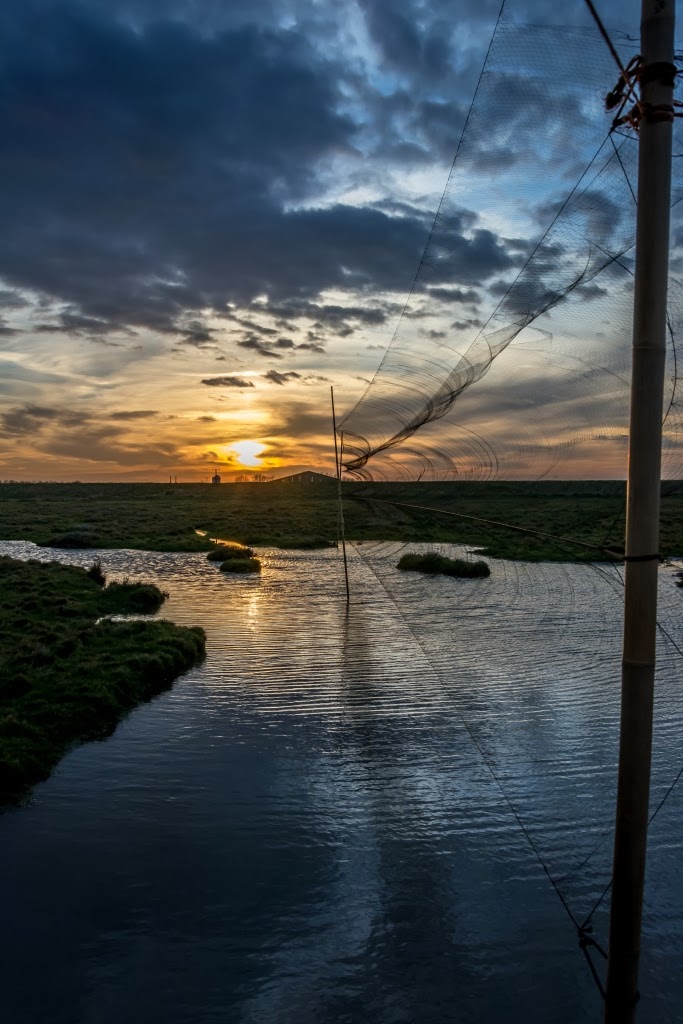
After lunch and a little bit of downtime, some of us went to set two groups of nets on the marsh for an evening’s mist netting. It was a little windier than was idea but it was a stunning afternoon and with the nets up, we went to check out the incredible whale bone. The jaw bone is all that is left of a sperm whale that washed up on the marsh approximately 10 years ago!

It was a little windy as we put the nets up

Sperm whale jaw bone with the 'white barn' behind 

Sunset over the white barn

There was a gorgeous sky as we left the marsh after setting the nets
As we sat on the marsh later that evening, waiting for birds to find the nets, Nigel commented that we only needed to catch another eleven birds to take the weekend total to over 500. Given the lack of birds and the slow rate at which they were being caught, we weren’t that optimistic! Luckily, we were wrong. A steady trickle of birds including two grey plovers (which were duly flagged), two oystercatchers, a single knot and a few dunlin (if my memory serves me correctly) took us over the magic number for the weekend. The early tide and small amount of birds meant that we finished at a very respectable hour white allowed us all to have an early night.

With the forecast for the morning looking very iffy, we headed to bed with alarms set for a reasonable hour with the intention of going colour ring re-sighting, but fully expecting to be able to stay in bed! As it turned out, when the alarms went off it was throwing it down and mass procrastination ensued. Eventually, we decided to go out anyway but restricted our locations to just Hunstanton or Heacham. I joined the majority at Heacham where we all got quite wet but saw lots of colour ringed turnstone.

Colour ringed turnstone with sanderling
When we returned to base, the comedy award for the weekend (we really should have one of these) went to the team of ringers who failed miserably to persuade a new double bed that it really did want to fit up the stairs to the annex. ‘How many ringers does it take to…’ was heard coming from a couple of the mouths of the amused onlookers! All-in-all it was another fun-filled weekend spent collecting really useful data with a great bunch of people. Bring on February!

Wednesday, 29 January 2014

October on the Wash

Looking at my blog recently I realised that I haven’t posted anything for ages and ages. This is, in part, due to the fact that I haven’t done much ringing in the past few months. It may also be down to a little bit of laziness in writing posts!

So, what have I been up to? Well, in October, I headed over to join WWRG for the weekend. After setting three nets on Snettisham Beach on Friday night, we were back nice and early on Saturday morning for the catch. The beach had plenty of grey waders on it and it didn’t take long before the command to ‘fire’ came through the radio and we were running to the nets to extract 533 sanderling, knot, grey plover and dunlin. It was a lovely catch with lots of great data gathered from the large number of sanderling re-traps (almost a third of the birds were already ringed).

Let no one ever say that ringers are lazy…no sooner had we finished breakfast than we were re-filling the trailer and tootling back down to Heacham to set two large mesh nets for a potential catch of oystercatchers that evening. We settled back in the sunshine and Richard read a few flags on curlew while we waited for the birds to turn up. Sadly, something about the beach, the tide, the weather, the whim of the birds made them decide not to come to the beach that evening so we had to undertake the frustrating task of picking up the un-fired nets before heading home for an early night!

On Sunday morning we split up into groups to go colour-ring re-sighting. I went to Snettisham Pits, where, in all honesty, I spent most of my time playing with my new camera lens! We were lucky enough to witness a spectacular roost which included approximately 55k knot and 28k oystercatchers. It also included one avocet with an identity crisis that sports flag M8. This slightly confused individual was apparently adopted by oystercatchers as a chick and seems to now spend its time exclusively with this species! For more info and pics, see the BTO’s blog: http://btoringing.blogspot.co.uk/2013/10/adopted-avocet-suffers-identity-crisis.html


As usual, it was a great weekend spent with good friends!

Waders at Snettisham

Knot flock at Snettisham

Sunday, 15 September 2013

Meadow pipits

Yesterday I had the pleasure of getting up at 04:15 to join David at a site near Leek (on the edge of the Peak Park) to try to mist net some meadow pipits. The site was ‘untested’ so neither of us was getting our hopes up too much before we arrived. However, as we set a couple of mist net triangles around hawthorn bushes, we could see and hear lots of birds. Nets set and sound lures on, we retreated to prepare a base and ringing station. Pretty soon, the birds started to show an interest and we took a walk to the nets. As we walked across the field, the birds on the ground flushed and a few flew in to join those already in the nets.

The first round returned a relatively small number of birds (all meadow pipits) which was good as it gave us time to study each bird closely and try to get to grips with ageing them. Having never handled a meadow pipit before (except for one straight out of the nest that was still growing its feathers) I found ageing them to be a little confusing! Their plumage seemed to be incredibly variable. Many were obviously young birds with clear moult limits but some, which looked uniform throughout the wing and which on first inspection looked as though they must be adults, turned out to be juveniles too.

The more we handled, the more variation we noted in size, plumage and fat scores. Interestingly, many of the birds had moulted the second greater covert in from the body, but no others. Many of the birds that had done that had also moulted the lower two tertials (secondary feathers seven and eight) but not the top one (secondary feather nine). Colour was extremely variable with some being quite bright whilst others were a far duller, more olive colour. The colour of the feet also varied between bright orange and dull pink.

Meadow pipit (with quite dull feet)

Note single greater covert has been moulted (second in from body).
In this bird, all of the tertials have also been moulted.

Moulting around the eye

One of the brighter birds we handled
The catching rate increased throughout the morning as the number of birds grew steadily (presumably as more migratory parties moved through). Part way through the morning, we took down one triangle and instead put up a couple of single 30’ nets between bushes. These started to catch with us still standing beside them! I was supposed to be leaving at 11:30 but at 11:15, having just extracted 30+ birds, I realised that this was not going to happen. At this point, we furled the remaining triangle, leaving just the two single nets for David to work with after I had gone.

When I eventually left (at nearer 12:30), we had handled 83 birds (82 meadow pipits and one reed bunting) which was far more than either of us expected. David stayed on until late afternoon and finished on 151 birds! Seeing 80+ individuals of one species in the hand in one morning is a fantastic way to learn about a species and I am very grateful to David for giving me this opportunity.