Saturday, 26 April 2014

A four day Easter weekend…what to do? Ringing, ringing, ringing, what else?

It all started on Friday when I spent the day checking tawny owl boxes with Jim in the south of Nottingham. I arrived at Jim’s in the morning full of high hopes that this season would prove to be a better season than last for this charismatic species. With ladders loaded, we set off in the Landrover to the first of the 24 boxes we were planning on visiting.

As the day progressed, we found box after box occupied. Unfortunately, they weren’t occupied by tawny owls! The last box before lunch contained an adult female tawny on small chicks and this turned out to be the only owl we handled all day (the chicks were too young to ring), but she was a pretty special bird all the same. She was first ringed by Jim in front of Central TV cameras in 2007 and was aged as an adult back then (aged as an 8 for the ringers reading this). She has only been caught once since then, in 2011. So, this lovely bird is at least ten years old and still going strong.

Beautiful tawny owl - if you look really closely, you might
be able to make out Jim reflected in her eye!
We found one other owl sitting tight (presumably on eggs) so we left her alone, and one other cold, abandoned egg (egg dump?). The remaining boxes were filled with stock doves, jackdaws or squirrels. Only four boxes were empty so, although not housing the target species, at least they are being put to good use. There are plenty of other boxes still to be checked so it is a little early to say that it isn’t a good year, but two out of 24 boxes wasn’t a great start. Here’s hoping the birds to the north of the Trent are doing a little better!

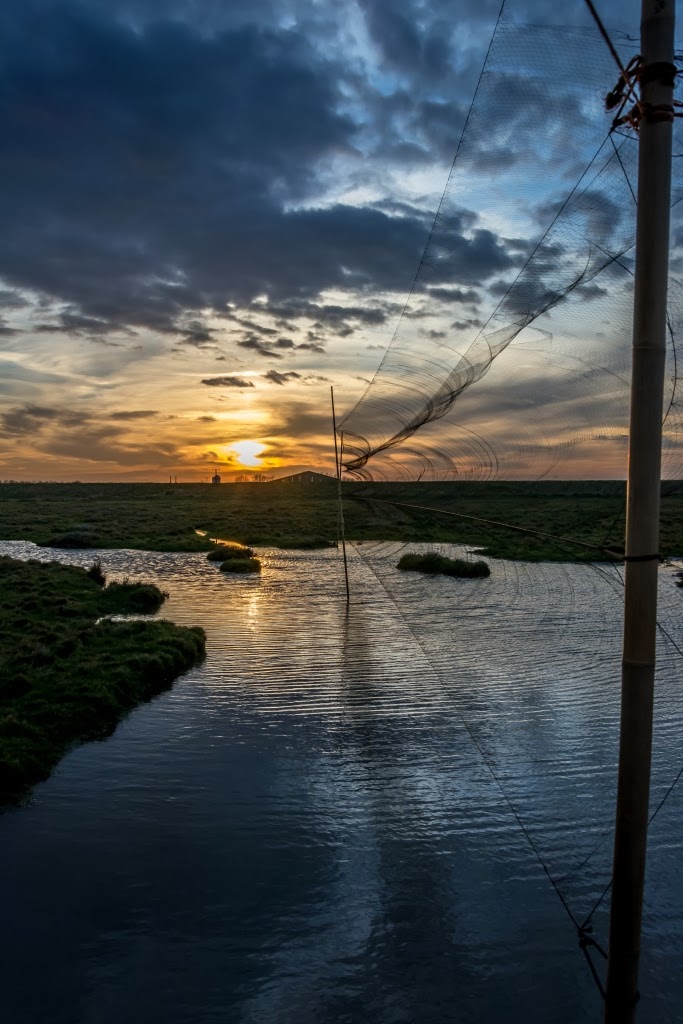
After lunch on Saturday with my family, I got back behind the wheel and trundled over to Norfolk to join a small group of WWRG members for an evening mist netting waders. Due to being a crock (bad back / hip) I helped to cook tea whilst the other members of the team set nets on both of the pools that we normally catch on at Terrington Marsh. It is not often that the tide times offer mist netting opportunities in April so we awaited dusk with keen anticipation.

It was chillier than expected once the sun bade us farewell for the evening (we had been spoiled by the recent mild weather) so it was back to the usual multiple layers usually associated with a Wash trip. The clear skies meant we had to wait longer than expected for it to be dark enough to head out onto the marsh to set the sound lures. Aron took his team out to the ‘E’ pool first and Nigel’s team (of which I was a part) twiddled their thumbs for a while before deciding it was just about dark enough to head out to the white barn nets. In truth, it was still light enough to easily see where we were going (which was a treat) so we tucked ourselves up against the inner sea wall for a few more minutes.

When Nigel returned from setting the sound lures, he was holding bird bags – it wasn’t going to be a blank evening at least! It didn’t turn out to be heaving with birds, but then we didn’t expect it to be. Instead, the birds trickled slowly into the nets which gave the new and inexperienced members of the Group chance to have a go at extracting in the dark – especially good fun when the nets are billowing in the stiff breeze. Sadly, despite the clear skies, the leonid meteor shower was not very evident but I did spot a good few satellites going over and the skyscape was mesmerising anyway.

At just past high tide we took the nets down and took the birds back to base to process. I joined the processing team where I took bill length and total head and bill length measurements for all of the birds. The catch comprised 35 dunlin and two of last year’s redshank. Interestingly, nine of the dunlin were of the schinzii race which is unusual to see at this time of year. 

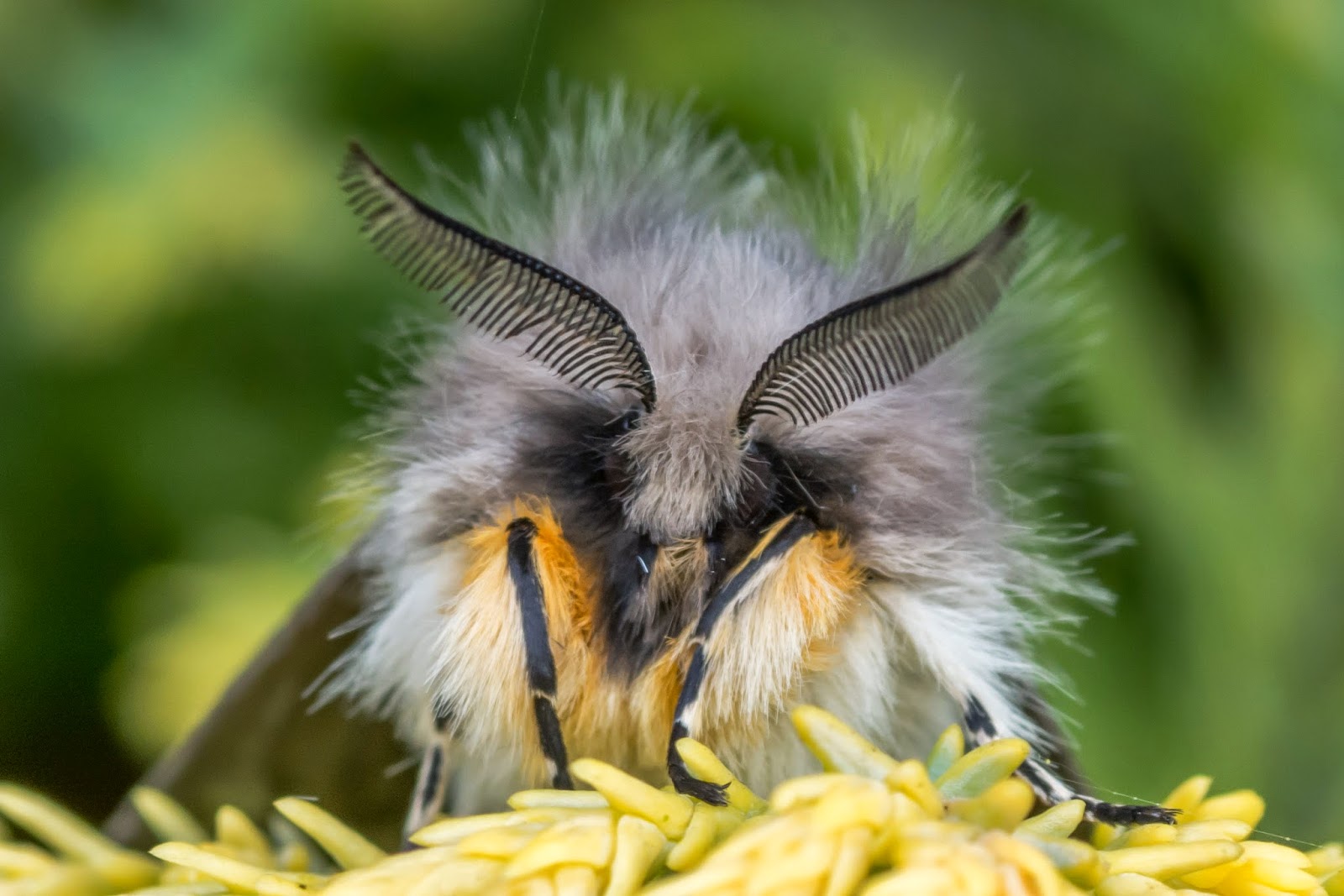
As the plan was to have a lazy Sunday morning (rain was forecast) I took the opportunity to set a moth trap up in the garden. I was pleasantly surprised to find three Hebrew characters, one muslin moth and one early grey in the trap when I checked it on Sunday morning. Unfortunately, the early grey flew away before I could capture a photograph of it but the other two species were more obliging. Despite the blustery conditions, I was able to get a couple of shots that I was quite pleased with.

Male muslin moth in all its glory
The very cute face of the male muslin moth 
Hebrew character moth - check out that eye!
As the weather was forecast to be wet and very windy on Sunday evening, we decided not to mist net at Gedney on Sunday night. So, by just before 11am, we were all on our way back to our respective homes (most unlike a Wash trip). So, it may have been short and sweet but it was a nice, relaxing weekend (by Wash trip standards).

The unsettled weather cleared up on Monday in time for the second visit to the heronry at Besthorpe Nature Reserve near Newark. The previously planned visit had been cancelled due to the weather so it was a relief that this weekend we were able to return to check the nests that had been occupied during the first visit.

On this occasion, the row over to the island was a much easier affair thanks to having two oars in the boat! The team was a smaller one than last time, so when all the people and equipment had been safely ferried across to the island, we set off as one group to the first tree. Now, some of you may know that I don’t have a particularly good head for heights so I am always extremely grateful that there are people out there that seem to enjoy climbing dead looking trees for us. This week, we had Andy and Richard to do the climbing and thanks to their valiant efforts, 26 chicks were collected, ringed and safely returned to their nests.

Andy in a tree - rather him than me!
Heron chick
Heron chick being ringed
Ringing in progress
By mid-afternoon the weather started to turn and the climbers started to tire so we called it a day. There were still more chicks to ring but the welfare of the birds takes priority and we had to let the adult birds return to their nests to feed their chicks and to prevent the remaining eggs from getting cold. The chicks that are still small enough to ring without risk of them jumping from their nests will be ringed on the next visit in May.

Surprisingly, there is also a tawny owl nest on the island so whilst we were there, we took the opportunity to check this too. In contrast to what Jim and I found on Friday, this box contained four healthy chicks that were duly ringed. When we had finished and packed up all the heron ringing equipment Jim and I nipped down to Girton to check yet another tawny owl box. We were delighted to find that this one was also occupied by a tawny owl on small chicks. A return visit in a week or so should see the chicks adorned with some uniquely marked metal work!

So, all in all, it was a fantastic weekend of ringing spent in great company. I was a little bit tired at the end of it though!

Sunday, 20 April 2014

Decoy making

Bird decoys are used during cannon netting to encourage passing birds to settle in the area in front of the nets. If made well, they will last many years but eventually, some will reach the end of their usefulness and new ones will be needed. Over the years, whenever a recently deceased bird that looks to be in good condition is found, it is put into the freezer until it is turned into a decoy. And so it was that last weekend nine members of the Wash Wader Ringing Group met at Nigel and Jacquie’s house to turn the frozen birds into a new batch of decoys.

The first task of the day was to process the (now defrosted) birds and record the details of where they were found, ring details (if ringed), age, wing length etc. After this, the day got a little gorier. I will spare you the details (or the photos) of how decoys are made, save to say it is a long, detailed and intricate process. The aim is to end up with a decoy that looks as realistic, and in as good a condition, as possible despite being stuffed full of cotton wool, wire, latex and formalin and having beads for eyes (oh and standing on a block of wood of course!). I came away from the weekend with a new found respect for taxidermists!

A little more work still has to be carried out once they are completely dry in a few weeks’ time (told you it was a long process) but by Sunday evening, 24 waders (curlew, black-tailed godwit, bar-tailed godwit, redshank, greenshank and knot) and one common gull had been re-born as decoys. Let’s hope they have long and fruitful afterlives helping us to catch lots more of their living relatives, and in so doing, help us to further our knowledge of their respective species.

Ready to be preserved (from the top: curlew, common gull,
bar-tailed godwit, redshank and knot)

Thursday, 3 April 2014

WWRG weekend

Last weekend I joined my friends at the Wash Wader Ringing Group for a weekend of ringing and colour ring re-sighting. Arriving on Friday evening I was told that we would be having a leisurely evening and going out colour ring resighting the next morning. That was fine with me!

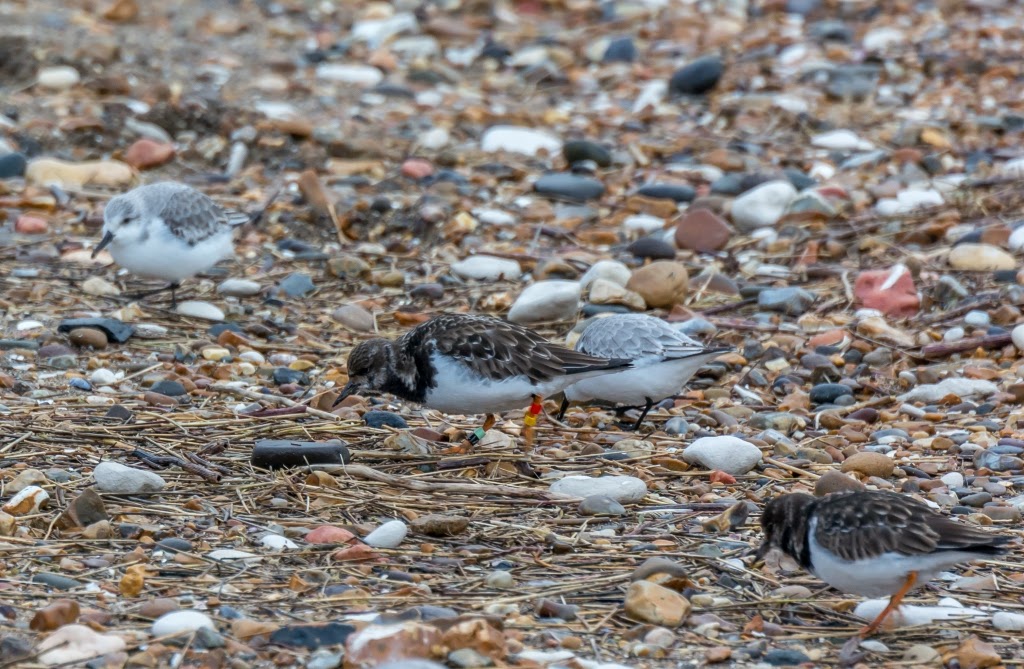
Saturday morning saw me teaming up with Ron to visit Heacham North and Heacham North North beaches. There are usually plenty of turnstone and sanderling on this beach and a high proportion of them are ringed, so the site is normally quite productive. The number of birds present this morning was quite low but the proportion of turnstone carrying colour rings was high which provided us with some great data.

Colour rings allow individual birds to be tracked throughout their lifetime without needing to catch them more than once. This allows information about longevity and movements to be collected very easily and without putting any undue stress on the birds. A morning spent recording fifteen or so individual colour ring combinations is therefore incredibly valuable. If you are out and about and see a colour ringed or flagged bird, please note the details and report it at www.ring.ac

Colour ringed turnstone
By 9am, we were back at base and before long we were tucking in to a hearty breakfast which would have to see us through until tea that evening. By mid-morning we were heading down to Heacham South Beach where we set two large mesh nets with the hope of catching some oystercatchers. Catching in the afternoon in lovely warm sunshine is a luxury that we are unaccustomed to, particularly in March, but a warm, sunny beach also has its downside when it comes to trying to catch waders… people! The team members positioned at each end of the beach to chat to members of the public were kept pretty busy and we even had to send someone out to chat to a photographer who had snuck up unnoticed over the sea wall and was quite close to standing on the nets by the time we reached him! That doesn’t happen  at 5:30am!

After the visitor had kindly moved back behind the sea wall, the catching effort resumed but we were not especially hopeful as the birds seemed to be favouring an area further down the beach from our nets. Luckily, things came together just in the nick of time and we were able to make a fantastic catch of 66 oystercatchers and a single turnstone. We processed the catch on the beach so were able to chat to lots of interested passers-by and tell them about the work we were doing and the conservation benefits of ringing. 

As we had a decent sized team and not too many birds, I was able to do some ‘double winging’, which is where two people measure the wing of the same birds to enable a comparison of their measurements to be made (some people measure shorter or longer than others). This data helps to ensure consistency between different ringers. I was very happy that I was pretty consistent with the person I was being compared to on every bird!

When we got back to base, Richard had a quick look at the ringing information for the birds that we had caught that already had rings on. We were astonished to find that one of the birds had been ringed back in 1980! We are waiting to hear how old it was when it was first ringed but whatever the answer, this bird was older than a few of the ringers.

Ringed oystercatcher (not the 34 year old one)
Being at the Wash on weekends when the clocks change can be a little confusing as we stay on GMT for the duration of the trip. Unfortunately, no-one ever tells that to our clever mobile phones. This year I remembered to switch off the alarm on my phone and relied instead on the old fashioned alarm clock that my room-mate had brought with her. Thankfully, this meant that I didn’t get up an hour earlier than necessary as I (and quite a few others) did last year. Getting up at 5am GMT (6am BST) was bad enough!

We spent the morning out colour ring resighting again and this time Ron and I visited Ken Hill looking for flagged curlew. There weren’t too many birds around on the fields that morning and we therefore only managed to find and read one flag, but that is still useful data. The most surprisingly element of the morning was the huge number of brown hares about – in one field alone, we counted fifteen! We were hoping for a bit of boxing action, but had to settle for a minor spat.

Flagged curlew
After another hearty breakfast we held the Group’s AGM before packing up and heading back to our respective parts of the country. 

Sunday, 23 March 2014

Ringing demo

This morning I had the pleasure of joining Jim, Geoff and Liz for a ringing demonstration for members of the Newark branch of Notts Wildlife Trust. The demo was at a site near Newark that Geoff and Liz have been ringing at for the past couple of months. The site has the potential for huge numbers of nets but given the volume of birds that are normally caught there, only three net rides were put up. The sky looked menacing when we arrived but soon cheered up to reveal beautiful blue skies and bright, bright sunshine (not a ringer’s best friend).

The first round produced a good number of birds and so did each subsequent round. The number and variety of birds caught kept the visitors interested and happy, as did the delicious breakfast rolls and cake provided by the very generous hosts. By mid-morning, the wind was beginning to cause a few problems and a sudden and sharp hail storm had us all running for cover into the ‘potting shed’. All but one net was furled, but this one still kept us busy.

The final total was 90 birds of thirteen species; goldfinch, greenfinch, chaffinch, yellowhammer, reed bunting, blue tit, great tit, long-tailed tit, lesser redpoll, robin, dunnock, blackbird and goldcrest. It was lovely to ring a redpoll again after such a long time without seeing one in the hand and I think I might have ringed more greenfinch today than I have in the previous six years of ringing!

It is always nice to ring on a new site and it was great to see so many different species in the hand in one day. Now, where can I find myself a site like that one… 

Friday, 21 March 2014

Ringing with NNRG

Last weekend I was lucky enough to be invited to spend the weekend ringing with the North Notts Ringing Group. First up on Saturday was a trip to Besthorpe Nature Reserve near Newark for the first heron check of the year. Heron’s can be very early breeders and in previous years, the first visit has seen many chicks ringed. The heronry is on an island which is only accessible via boat. So, when the dingy was inflated, I was given the task of rowing across to the island. The idea was to secure a long rope to a tree on each bank to allow all the equipment and other ringers to make the journey across easily via a pully system. Sounded simple! Unfortunately, there was only one oar and a strong current so rowing across wasn’t quite as simple as it sounded! After negotiating a few low branches, we made it across and soon had the equipment and the rest of the team onto the island.

With the teams briefed and the climbers geared up, we collected the ladders, mirrors, buckets and clip boards and set off, eager to ring some chicks. Jez and Andy admirably climbed tree after tree and checked nest after nest. The result was 22 active nests. Unfortunately, the high winds of recent weeks appeared to have taken their toll on early breeding attempts. It seemed that birds had either delayed breeding or eggs had blown out of nests as all of the active nests contained either eggs or chicks that were too young to ring (1 nest). So, a nice morning but unfortunately nothing ringed. The next visit should be more productive.

After a picnic lunch in the sunshine, we headed off to Out Ings, near Sturton le Steeple along the River Trent, to set cannon nets in readiness for an attempt to catch wigeon the following morning. With two nets set, we trundled off home with the words ‘see you at 5am’ hanging in the air.

At 5am on Sunday morning, the team met up at Adrian’s house (sorry neighbours) before heading back to Out Ings. Jim warned us that last time, they had to wait about 8 hours before a catch was made…so we settled down and started to wait. Approximately 15 minutes later Jez came over the radio to say that there were a few birds in the catching area and we should be ready. Less than five minutes later we were careering across the field towards the smoking cannons.

It was a stunningly beautiful day and it turned out to be a great catch. Approximately 75 birds, mostly wigeon, but also a few mallard, coot and greylag geese were caught and processed. One of the female wigeon was a little unusual, with a bright greenish tinge to the secondaries (as is more normal on males, although males would be brighter) and an odd stripe down the beak. I would be interested to hear if anyone else has ever seen a similar bird.

It was a fabulous weekend and was great to catch up with people I hadn’t seen in a while. Hopefully I will be able to join the team again for the second heronry visit in the next couple of weeks.

Birds keeping calm in bags before being ringed  
Male wigeon
Female wigeon
Male mallard
Crazy coot feet
Unusual plumage on female wigeon wing
Unusual beak markings on female wigeon

Thursday, 27 February 2014

Wind? What wind? Oh, that wind…

A week in advance of the trip, the forecast for the last Wash weekend was looking poor so it was no surprise to get an email from Jacquie on Friday morning telling us not to hurry to Norfolk as we would not be going out to set nets that evening. After an horrendously wet and windy drive, I joined the other hardy souls that had laughed in the face of the elements for a delicious Thai pumpkin soup and a relaxing evening.

Instead of trying to catch in 60mph+ winds on Saturday morning, we all headed to different beaches to do some colour ring re-sighting. I went to Snettisham Pits, interested to see how it was recovering from the December storms. The sight was a sad one, with three of the four hides destroyed and obvious devastation around the reserve. The winds were the strongest I think I have ever encountered and it was a real effort to walk down to the wader watch point. We soon retreated to the only hide still standing and tried to keep our scopes still enough to see some flags. Well, we did see flags but unfortunately, the birds were too far away to read them. It was fun watching the birds having as much trouble standing still as we were! The walk back to the car park was more of a trot at times as the wind pushed us along.

The afternoon was spent doing jobs around the house and doing some ‘gardening’ along the access route to Snettisham. That evening, the wind seemed to have dropped a little and we were finally able to think about doing some ringing. We set three large mesh nets on the beach at Heacham South with the hope of catching the oystercatchers and barwits that had been on the beach during the recent recces.

At 05:30am on Sunday we headed back to Heacham, settled in at base camp, listened to the sound of oystercatchers on the beach, watched the sunrise and the pink-footed geese flying around the fields behind the beach and crossed our fingers. The recent stormy weather affected the tide and caused it to make considerably, meaning it was too high up the beach before it was light enough to catch safely. Phil took the decision to wait for the falling tide but unfortunately the birds were jumpy and spooked out of the catching area. Despite valiant efforts to twinkle the other birds on the beach, it wasn’t to be and we were soon collecting in the unfired kit.

As it was such a beautiful morning, we decided to go colour ring re-sighting at Heacham North beach and were rewarded with a very high proportion of ringed birds. As I didn’t have a scope with me, I took full advantage of the gorgeous light to take a few photographs (okay, so I sat on the beach for an hour taking pic after pic after pic) including a few of ringed and colour ringed birds. The best shots can be seen on my photography website In Nature's Image

Colour ringed turnstone

One ringed knot in there
On Sunday evening a few members of the Group stayed on to try mist netting at Gedney. They were rewarded with six birds so the weekend wasn’t a complete blank on the bird front. Let’s hope the weather is a little more kind to us in March!

Thursday, 30 January 2014

Snow stops play

With a couple of days off work, I jumped at the chance of joining Jim, Duncan and Tom at the winter feeding site at Granby this morning. The site is affectionately known as the Granby Fridge Experience (for reasons that become painfully obvious to anyone who goes there) but for the most part, it didn't live up to its name today…that was until it started snowing!!!

The nets were up by about 07:30 and we feared a quiet morning as there had been little calling or flying along the former railway line as we set. The first round did nothing to dispel this fear as it returned only a few birds. The second round was better and this was the point at which our fingers started to disagree with the rest of us about the temperature.

As we finished processing the birds, a few flakes of snow started to fall. Hoping it was our imagination we carried on regardless. By the time we were extracting the birds on the third round, we were being covered by large snowflakes and we had no choice but to close the nets. The birds (in bags) took shelter in Jim’s landrover and we did our best to process them with painfully frozen fingers.

Snow soaked chair

Birds keeping dry in the landrover
We took the nets down at 10am and packed up. By the time everything was away, the snow had stopped and we were debating whether we had been too hasty to pack up but we decided to stick to our decision. The drive out of the site became a little eventful when the landrover decided to drive sideways instead of forwards! A little digging and a little pushing later and we were on the move again, just as it started raining.


Oops. It really shouldn't be at that angle!
Despite the shortness of the session, it was nice to be out at Granby again. We caught 30 birds of seven species, with the majority of individuals being great tits, blue tits or yellowhammers.

New website

The other reason for the lack of posts on here recently is that I have been busy with a new venture. As some of you may have guessed from this blog, I am quite keen on photography. After much procrastinating, I have finally got around to creating a photography website. The site will be showcasing my favourite photographs and (hopefully) will be updated on a regular basis. The site also contains a blog which, surprisingly, will be photography focused.

If you would like to take a look, please head over to www.innaturesimage.co.uk. Feel free to leave me a message in the guestbook!


Passerine ringing

I haven’t been passerine ringing for what seems like a very long time so it was with a little trepidation that I found myself driving out to Brackenhurst the other Sunday to join my friends in the South Notts Ringing Group. Thoughts such as ‘will I remember how to age a yellowhammer?’ were running through my head as I negotiated the A617. Luckily, it seems as though ringing is a bit like riding a bike; you soon remember how to do it once you get back on it.  

We met at a respectable 7am and set both the feeder nets and the nets in Orwin’s plantation. The sound lure in Orwin’s failed to attract much at all, except for one fieldfare, one goldcrest, one robin and possibly the odd tit (my shocking memory is why I should write these posts closer to the events!). Thankfully the feeder nets did much better, until the wind decided to come out to play that is! We packed up early, finishing on 56 birds which was approximately half the previous week’s tally, despite the weather apparently being very similar.

The totals included tree sparrows, yellowhammers and a greenfinch, the latter of which is a bit of a rarity round here these days! It is always lovely to see tree sparrow in the hand and it was good to refresh my memory on the intricacies of ageing yellowhammers. Unfortunately, the large flocks of thrushes that were teasing us by flying around the field all morning didn’t respond to the sound lure and neither did the green woodpeckers that were calling to each other throughout the session. Good job there is always a next time J

It felt really good to be ringing passerines again and it was great to catch up with some members of SNRG that I haven’t seen for a very long time!

First Wash of the year…

The last Wash trip of 2013 was in December and unfortunately, it clashed with the BTO Conference in Swanwick. I chose to attend the conference, which meant that I didn't get to catch any birds, but I did get to spend the weekend with a large number of the Wash regulars! It was a fantastic weekend with many interesting and informative talks.

Having not been ringing with WWRG since October, I was raring to go when the first Wash weekend of the year came in January. I arrived at the house on Friday evening just as Phil was heading out and round to Gedney to join the early birds who had been able to get there in time to go mist netting. I settled in, chatted to the few others who were there and waited for Nigel to arrive. When he did, it was all hands on deck to load the cannons and the trailer ready to set four nets at Snettisham Beach after high tide. After a warming bowl of soup, we trundled down to Snettisham to set four small mesh nets. We were met by the Gedney team who had managed to catch 38 birds. A great start to the weekend.

After an efficient net set, we headed home for a briefing and bed for a few short hours. Before we knew it, it was morning and we were heading back to Snettisham, keeping our fingers crossed that the sanderling that had been on the beach yesterday had decided to return. We snuggled down at base camp and waited for there to be enough light for Nigel to see the catching area. Luckily, the birds were there and after a little gentle twinkling they were in the right place and we were soon hurtling down the beach to the nets. We were delighted to find over 450 sanderlings in the net, including a huge number of re-traps. More great data! We managed to fully process all of the birds well within the four hour window which was fantastic.

After lunch and a little bit of downtime, some of us went to set two groups of nets on the marsh for an evening’s mist netting. It was a little windier than was idea but it was a stunning afternoon and with the nets up, we went to check out the incredible whale bone. The jaw bone is all that is left of a sperm whale that washed up on the marsh approximately 10 years ago!

It was a little windy as we put the nets up

Sperm whale jaw bone with the 'white barn' behind 

Sunset over the white barn

There was a gorgeous sky as we left the marsh after setting the nets
As we sat on the marsh later that evening, waiting for birds to find the nets, Nigel commented that we only needed to catch another eleven birds to take the weekend total to over 500. Given the lack of birds and the slow rate at which they were being caught, we weren’t that optimistic! Luckily, we were wrong. A steady trickle of birds including two grey plovers (which were duly flagged), two oystercatchers, a single knot and a few dunlin (if my memory serves me correctly) took us over the magic number for the weekend. The early tide and small amount of birds meant that we finished at a very respectable hour white allowed us all to have an early night.

With the forecast for the morning looking very iffy, we headed to bed with alarms set for a reasonable hour with the intention of going colour ring re-sighting, but fully expecting to be able to stay in bed! As it turned out, when the alarms went off it was throwing it down and mass procrastination ensued. Eventually, we decided to go out anyway but restricted our locations to just Hunstanton or Heacham. I joined the majority at Heacham where we all got quite wet but saw lots of colour ringed turnstone.

Colour ringed turnstone with sanderling
When we returned to base, the comedy award for the weekend (we really should have one of these) went to the team of ringers who failed miserably to persuade a new double bed that it really did want to fit up the stairs to the annex. ‘How many ringers does it take to…’ was heard coming from a couple of the mouths of the amused onlookers! All-in-all it was another fun-filled weekend spent collecting really useful data with a great bunch of people. Bring on February!

Wednesday, 29 January 2014

October on the Wash

Looking at my blog recently I realised that I haven’t posted anything for ages and ages. This is, in part, due to the fact that I haven’t done much ringing in the past few months. It may also be down to a little bit of laziness in writing posts!

So, what have I been up to? Well, in October, I headed over to join WWRG for the weekend. After setting three nets on Snettisham Beach on Friday night, we were back nice and early on Saturday morning for the catch. The beach had plenty of grey waders on it and it didn’t take long before the command to ‘fire’ came through the radio and we were running to the nets to extract 533 sanderling, knot, grey plover and dunlin. It was a lovely catch with lots of great data gathered from the large number of sanderling re-traps (almost a third of the birds were already ringed).

Let no one ever say that ringers are lazy…no sooner had we finished breakfast than we were re-filling the trailer and tootling back down to Heacham to set two large mesh nets for a potential catch of oystercatchers that evening. We settled back in the sunshine and Richard read a few flags on curlew while we waited for the birds to turn up. Sadly, something about the beach, the tide, the weather, the whim of the birds made them decide not to come to the beach that evening so we had to undertake the frustrating task of picking up the un-fired nets before heading home for an early night!

On Sunday morning we split up into groups to go colour-ring re-sighting. I went to Snettisham Pits, where, in all honesty, I spent most of my time playing with my new camera lens! We were lucky enough to witness a spectacular roost which included approximately 55k knot and 28k oystercatchers. It also included one avocet with an identity crisis that sports flag M8. This slightly confused individual was apparently adopted by oystercatchers as a chick and seems to now spend its time exclusively with this species! For more info and pics, see the BTO’s blog: http://btoringing.blogspot.co.uk/2013/10/adopted-avocet-suffers-identity-crisis.html


As usual, it was a great weekend spent with good friends!

Waders at Snettisham

Knot flock at Snettisham

Sunday, 15 September 2013

Meadow pipits

Yesterday I had the pleasure of getting up at 04:15 to join David at a site near Leek (on the edge of the Peak Park) to try to mist net some meadow pipits. The site was ‘untested’ so neither of us was getting our hopes up too much before we arrived. However, as we set a couple of mist net triangles around hawthorn bushes, we could see and hear lots of birds. Nets set and sound lures on, we retreated to prepare a base and ringing station. Pretty soon, the birds started to show an interest and we took a walk to the nets. As we walked across the field, the birds on the ground flushed and a few flew in to join those already in the nets.

The first round returned a relatively small number of birds (all meadow pipits) which was good as it gave us time to study each bird closely and try to get to grips with ageing them. Having never handled a meadow pipit before (except for one straight out of the nest that was still growing its feathers) I found ageing them to be a little confusing! Their plumage seemed to be incredibly variable. Many were obviously young birds with clear moult limits but some, which looked uniform throughout the wing and which on first inspection looked as though they must be adults, turned out to be juveniles too.

The more we handled, the more variation we noted in size, plumage and fat scores. Interestingly, many of the birds had moulted the second greater covert in from the body, but no others. Many of the birds that had done that had also moulted the lower two tertials (secondary feathers seven and eight) but not the top one (secondary feather nine). Colour was extremely variable with some being quite bright whilst others were a far duller, more olive colour. The colour of the feet also varied between bright orange and dull pink.

Meadow pipit (with quite dull feet)

Note single greater covert has been moulted (second in from body).
In this bird, all of the tertials have also been moulted.

Moulting around the eye

One of the brighter birds we handled
The catching rate increased throughout the morning as the number of birds grew steadily (presumably as more migratory parties moved through). Part way through the morning, we took down one triangle and instead put up a couple of single 30’ nets between bushes. These started to catch with us still standing beside them! I was supposed to be leaving at 11:30 but at 11:15, having just extracted 30+ birds, I realised that this was not going to happen. At this point, we furled the remaining triangle, leaving just the two single nets for David to work with after I had gone.

When I eventually left (at nearer 12:30), we had handled 83 birds (82 meadow pipits and one reed bunting) which was far more than either of us expected. David stayed on until late afternoon and finished on 151 birds! Seeing 80+ individuals of one species in the hand in one morning is a fantastic way to learn about a species and I am very grateful to David for giving me this opportunity.

Mist netting with WWRG

Two days ringing barn owls didn’t seem like quite enough excitement for one weekend, so Sunday afternoon saw me heading over to Norfolk for an evening’s mist netting on Terrington Marsh. A small team assembled at base and pretty soon we were all trundling along to the sea wall with the mist nets and poles. We set three sets of nets, one on ‘E’ pool, one on the cannon netting pool and one between these two. These last two pools hadn’t been used before as mist netting pools (to my knowledge anyway) but often held large numbers of waders (judging by the noise heard coming from them during previous mist netting sessions on the marsh) so hopes were quite high for a good catch.

After a quick tea, we returned to the marsh to set the sound lures and wait for the birds to arrive. We didn’t have to wait for long. Catching on all three sets was steady throughout the evening and we were kept busy until a little after high tide when we took the nets down. The team I was in was last off the marsh and by the time we were back, the processing team was up and running and birds were already being ringed. This meant that there was nothing for me to do but to pick up a pair of pliers and put some rings on birds J

We ended up with another good sample of redshank to add to the samples made earlier in the summer. In addition, we caught about eight ringed plover (very good number for mist netting), a few dunlin, a knot and the star bird of the evening… a little stint! Most people in the group had never seen one of these in the hand so I was feeling very lucky to have been there that night. It was a stunning little bird and, whilst every trip to Norfolk is worthwhile, this made it all the more special! I am looking forward to seeing what the October trip brings.


Thursday, 12 September 2013

Barn owls…at last!

So far, this year seems to have been a shocking year for barn owls.  The long cold winter saw many adult birds die, particularly in late March (see http://btoringing.blogspot.co.uk/2013/04/cold-spring-hits-barn-owls.html). This, coupled with a poor breeding season last year due to the bad weather in late summer meant that there were seemingly fewer birds around to breed. Across the country it seems that barn owls are having a pretty tough year (see http://btoringing.blogspot.co.uk/2013/07/spring-weather-bad-news-for-barn-owls.html).

So, I was not overly optimistic about finding many chicks to ring when I went out with Jim this weekend. On Saturday, Jim, Emma and I returned to check a few boxes around the Southwell and Flintham areas that had had eggs or very young chicks on the first visit. The first two occupied boxes contained three chicks and an adult each (the first adult being six years old). This was followed by a box of four chicks and an adult and a box with a couple of stock dove chicks in.

When we arrived at the last occupied box, the owner mentioned that there were some campers in the field near the box who would like to watch if we found anything to ring. Well, it was certainly their lucky day. Jim went up the ladder (this one was a little too high for me) and confirmed that the box was occupied. As I stood at the bottom with the campers, Jim carefully took the first chick out of the box, then the second, third, fourth, fifth, six and seventh!!! And then came mum! It was stunning to see so many healthy looking chicks in a single brood. It will need a mild few weeks and a lot of luck for all seven to fledge though – fingers crossed!

Jim braving the tall ladder
 
These are quite possibly the most photographed barn owl chicks
in Nottingham
On Sunday, Jim and I checked a few boxes in the Vale of Belvoir. We didn’t have quite such a productive morning with only a single barn owl chick ringed. One other box had an adult on eggs and one had an adult on six very young chicks that were too small to ring. We also found a single stock dove chick. Bizarrely, when arriving at one box, which was in a dilapidated barn located next to some hard standing with a manure heap and a puddle of highly contaminated (by the manure) water, we flushed four snipe! Not what we were expecting to see.

What was really interesting for me this weekend was the opportunity to process six adult female barn owls. All the birds were ringed birds, so were of known age. It was fascinating to see birds with similarly aged chicks in different stages of moult and to be able to spend a little time looking closely at the different ages of their feathers. Unfortunately, the photos I took don’t show the subtle differences in colour very well but in this image you can just see the different shades of white on the feathers and see that this bird was still in active moult. This bird was ringed as a chick in 2007 so is six years old.

So, by the end of the weekend, we had ringed eighteen barn owl chicks, which doubled the number ringed by the South Notts Ringing Group (SNRG) this year. It appears that the warm summer has encouraged birds to try to raise late broods (whether these are second broods or late first broods would be interesting to know). I hope that the weather in the next few weeks is kind to these birds and that the majority of them manage to fledge.

For more information and for the possible reasons for the poor year, see Jim’s post on the SNRG blog (http://southnottsringinggroup.blogspot.co.uk/2013/09/its-all-over-now-or-is-it.html).

Monday, 2 September 2013

WWRG Main Week

It hardly seemed a minute after returning from the Wash mini week when it was time for the Wash main week. Work commitments meant that I couldn’t make it until Tuesday afternoon but luckily for me, I didn’t miss any catches on the Tuesday morning. As I arrived at the base, Kirsty was just running out of the house with the team’s tea. After a very quick comfort break I followed her down to the marsh to join the small team that had set a single net hoping for a greenshank catch. I soon learned that the rest of the team were over on the Lincolnshire side helping the other team on that side of the Wash.
 
After a lovely tea we settled in to wait for the birds. With Nigel keeping us informed of what was in the area, we waited expectantly and we weren’t disappointed. It wasn’t long before we were running to the net and extracting four beautiful juvenile greenshank. This was a new species in the hand for three of us so it was fascinating to be able to study them, particularly as it was still daylight. All of the birds were colour ringed as part of an on-going project being carried out elsewhere in the UK.
 
Ringing a greenshank
The birds were all individually colour marked

 
Later that evening we headed down to Snettisham Beach to set three nets for the following morning. Given the small team present, it was a remarkably efficient set and we were soon heading back to base for a good night’s sleep. The next morning we were up bright and early and back at the beach for a lovely sample of sanderling with a few dunlin, a single knot and a fantastic grey plover still in full breeding plumage. One of the sanderling was a rather special bird that has become the star of its own post on the BTO’s ‘Demog blog‘ - http://btoringing.blogspot.co.uk/2013/08/the-return-of-sanderling-nt88726.html
 
On Wednesday afternoon we set nets in a field Lucy had seen large numbers of curlew, godwits and golden plover landing in that morning. We decided to man the nets on Wednesday evening on the off chance that the birds may come in but without high expectations. With a few golden plover around, it looked as though there may be an option for a catch, but despite our best efforts, it wasn’t to be. So, we left the nets in place and headed home, with a few stops along the way to gaze at and take photos of the stunning sunset. The following morning we were back in position at the field but sadly, despite there being hundreds of curlew and godwits around, they just didn’t want to settle in our field.
Cathy and Justin demonstrating how to
put up a hide on a sloping drain bank
 
The start of the sunset over Terrington Marsh. Later the entire
sky turned a vivid red!
On Thursday evening a few of us decided to check out the greenshank pool again but unfortunately, it had too much water in it for us to set any nets so we headed back to base for a relaxing evening and an early night. Friday morning saw us over at Ken Hill manning a series of nets that we had set in a field the previous day. We were again looking to get a sample of curlew. After a coordinated twinkle, we had the opportunity to make a catch and we were soon busy with 50+ curlew. It was a nice sample which made all the hard work of setting in the grass field the previous day worthwhile.
 
On Friday night, as there were no viable catching opportunities, we had planned on meeting up with the Lincolnshire team for a meal out but given that it was the start of the bank holiday weekend and the traffic was horrendous, we thought better of it. Instead we made the most of the lovely evening and had a delicious BBQ at the Norfolk base. It was a treat to be able to just relax and chat with friends for the evening.
 
Team BBQ - and no, I have no idea why Guy has that look on his face!
Saturday morning saw us once again trying our luck with the nets set for curlew. Alas, this time we were thwarted by rain and a peregrine. We did however get to watch a stunning encounter between the peregrine and a golden plover. There was mixed feelings between those watching as to whether we wanted the goldie to get away or whether we wanted the peregrine to get some breakfast so as to stop bothering the birds in our field. In the end, after an incredible and prolonged chase, the goldie escaped the peregrine’s talons (I was in the goldie to win camp so was pleased with this outcome)!
 
Saturday and Sunday evenings were earmarked for mist netting on the marsh. I love mist netting at night, particularly at this time of year as you never know what you are going to catch. On my first trip to the Wash, three years ago this September, we caught at least thirteen different species in the mist nets. The visitors to the nets this weekend weren’t quite so varied but we did catch a really nice sample of redshank over the two nights. Other species caught included knot, ringed plover, black-tailed godwit, bar-tailed godwit, dunlin, turnstone and a solitary juvenile black-headed gull, which I was lucky enough to ring. I have never before held an adult gull and was pleasantly surprised by how soft its plumage was.
 
Juvenile black-headed gull
A late finish on Saturday night blended into an early start on Sunday morning as we went and set nets on the marsh in an attempt to increase our redshank sample for the week. Nets set, we all settled down under the tarpaulin to wait for the birds to come into the pool. A message soon came over the radio from Nigel in the hide informing us that the firing box wasn’t working and asking whether anyone had any batteries. A set of AAs was duly produced and Nigel set about trying to fix the box. A minute later there was a popping sound (okay, more like a quiet bang) and the words ‘and that was me blowing up the firing box’ were heard from the hide! Hmmm, this wasn’t going well. But Nigel had a plan to fire the box via the batteries themselves. We just had to wait for the tide and the birds…neither of which materialised. A sparrowhawk came to visit and a marsh harrier was spotted in the distance but the pool we were set on remained resolutely void of birds. We eventually gave up and went back to base where Nigel decided to test out the makeshift firing equipment. As it turned out, the batteries wouldn’t have fired the nets anyway so it was probably a good thing that we didn’t have a decent catch option after all! In the arable field, where a small team were again manning the curlew nets, no birds showed up either.
 
The week ended on Monday morning with a lie in and a morning spent sorting kit, cleaning up the house, dismantling tent city and disentangling dogs from nets that had been left out to dry! A surprising amount of sleep had been achieved this week but most people were still pretty tired by the time they all departed on Monday afternoon. So, that’s another summer season on the Wash over and done with. Roll on the October weekend!
 
I would love to know whether Meg
was standing there out of concern for
Semi under the net or whether she was
just laughing at her!