Sunday, 5 May 2013

More sleep deprivation... and a hail storm!

Another weekend, another visit to Norfolk to ring with the Wash Wader Ringing Group. The team met on Friday evening and found the times for the evening and morning’s activities written on the board. ‘Umm, are those timings correct?’ was heard to be uttered a number of times before Nigel returned from his recce of Terrington Marsh to confirm that they were indeed accurate. In fact, they weren’t… instead of having the three and a half hours sleep that the board suggested we would get, we actually only got around two hours!!! 

Aron’s recce on Friday morning had found a good collection of grey waders (knot, grey plover, sanderling, dunlin etc.) on Snettisham Beach so, on Friday evening, we set three nets in anticipation of the morning tide. Unfortunately, the birds had other ideas and found themselves a better place to be on Saturday morning. Just as we were beginning to get disconsolate, a flock of ringed plover appeared in the catching area. We were able to take a small (but useful, as we don’t ring huge numbers of ringed plover) catch of eighteen ringed plover and three turnstone. I was part of the processing team for the catch but did manage to ring one bird which was a treat as I have only ever handled one ringed plover before. The processing team had to de-camp into the back of Aron’s car when a hail storm made ringing in the open problematic – not what we expect in Norfolk at the end of April! 

After breakfast, the team all headed back to bed for a couple of hours of well needed sleep. Refreshed and ready to go again, we headed to Heacham Beach in the afternoon to set two nets for an evening catch of oystercatchers. A nice catch was made of 56 birds, including a 21 year old retrap! I was in the processing team again, but thankfully, no hail storms interrupted us this time. 

After an early night some members of the group went out colour ring re-sighting on Sunday morning, whilst the crocks amongst us (me included) stayed behind and did jobs around the base. When all were back, the group held its AGM before everyone headed home for another early night!

Cormorants and herons

A couple of weekends ago I joined Jim, Gary and Mick at Attenborough Nature Reserve to (hopefully) ring cormorant and heron pulli. It was a gorgeous morning and as we met, the nature centre car park was filling up fast with visitors eager to enjoy the long awaited sunshine. Rob (who works at Attenborough) soon arrived and he and Mick headed off to collect the boat. A few minutes later and we were life jacketed up and chugging out to one of the many islands on the reserve.
 
Cormorant nests on one of Attenborough's many islands
As we neared, we assessed the age of the birds we could see on nests to ensure that none of them were old enough to be likely to try to leave their nests in our presence. Thankfully, they were all small enough to ring safely so we landed at the end of the island and Mick got to work with his climbing gear. Pretty soon, he was up the tree and lowering the chicks down to us. As we ringed the chicks, Mick added a number to each nest to allow us to monitor the nests more easily in future.
 
Mick climbing up to the nests
 
Cormorant nest number
The chicks were ringed with both a metal ring and a darvic (colour ring) so that they can be monitored without needing to be recaptured. First nest done, we moved along the island a little, numbering nests as we went. We ringed a second brood of chicks under the watchful eye of another of the island’s inhabitants.
 
Canada goose watching us ringing cormorants
 
Me with a cormorant chick
Cormorant chick with darvic
After ringing two broods, we left the island, as we didn’t want to keep the adults off the nests for too long, and went to check on a heron nest whose chicks had been too young to ring on the previous visit. The chicks were now a perfect size and we were able to add metal rings and colour rings to these birds too. With the pulli ringed and safely back in the nest, we headed back to the nature centre. The wind had picked up to levels that were both unsafe to climb in and too cold for adult birds to be off chicks for long so we called it a day.
 
Mick with a heron pullus ringed and ready to go back in the nest
Hopefully, data gathered from future sightings of the colour ringed herons and cormorants will provide currently unknown information such as whether they nest in the same nest each year, whether chicks return to their natal site to breed, longevity and so on. Attenborough Nature Reserve is a very heavily visited reserve so hopefully, lots of re-sightings will be reported for these birds. It will be fascinating to see what can be learned in the years to come.
 
Thanks to Gary for the cormorant pictures.

Thursday, 4 April 2013

Easter Weekend...Part 3 - Who Needs Sleep?

So, the ‘somewhere else I needed to be’ that prevented me from staying in Norfolk on Sunday evening was Brackenhurst on Monday morning. At 6am, I joined Jim, Gary, Duncan and Emma for a morning’s ringing at one of our winter feeding sites. It was a bitterly cold morning that should have yielded good numbers of birds in the nets. Unfortunately, this wasn’t to be.

The morning started auspiciously enough when a woodcock flushed from one of the rides that we were setting nets in. Despite Jim and Gary’s best efforts during the morning, it didn’t want to play and refused to be flushed into the nets. The net rounds started slowly with just a few birds each time and to be honest, they didn’t get much better. There just didn’t seem to be many birds around.

The highlight of the day for me was a goldcrest. They are stunningly beautiful little birds and I haven’t seen one in the hand for a while, so it was a treat to get to ring that. A re-trap tree sparrow was also nice to see. The first of this year’s migrants paid us a visit – one chiffchaff who responded remarkably quickly to the sound lure. Interestingly, most of the re-traps that we caught were adults, heightening our suspicions that last year was a disastrous breeding season. A lot of the chaffinches we caught also had high fat scores indicating that they may be continental birds that haven’t yet set off on the return journey to their breeding grounds.
 
Gorgeous little goldcrest
First spring migrant of the year
We gave up late in the morning when the winds became too strong and we could no longer feel our fingers! Twas a nice morning, despite the cold and the low avian turnout!  

Oh and in answer to the question in the title, by the end of the weekend, I did!!!

Wednesday, 3 April 2013

Easter Weekend...Part 2 - Ringing on the Wash

With my WeBS counts done, it was now time to head over to Norfolk to join the Wash Wader Ringing Group for a weekend’s ringing. Arriving on Friday evening, it soon became clear that it was going to be a long night! With the equipment sorted, introductions done, a lovely tea eaten and the tide receding, we headed out at 9pm to set nets for an attempted cannon net catch on Saturday morning. The Friday morning recces had found approximately 20 000 knot on Snettisham Beach so hopes were high for a good catch. 

As the team started to set the nets under a cold, starry sky, the moon rose big and beautiful over Ken Hill behind us. The tide was still receding and as the cannon net holes were dug, they soon began to fill with water, preventing us from filling them in. Still, there are plenty of other things to do when setting cannon nets so by the time we had finished, the water was low enough to fill the holes without the risk of the cartridges getting soggy!

By the time we got to bed it was half past midnight, which in and of itself, isn’t too bad. However, when you factor in the fact that the alarms were set for a quarter to four the following morning, it was a tad evil!!! So, a very small amount of sleep later saw us heading back to Snettisham and by just after 5am we were shivering at base camp. The briefing had suggested that if we hadn’t caught by 6am, we would be rushing to lift the nets out of the way of the rising tide. We therefore did what we always do…we waited.
 
Nigel kept base camp informed over the radio and soon reported that we had 100+ knot in the catching area. With plenty more on the mudflats, hopes were high. Not long after, all the knot headed to the Pits! Luckily, a flock of oystercatcher turned up and Nigel gave the order to arm the box. Cue the adrenalin. It’s a strange thing how the adrenalin starts pumping and at the same time, the nerves start to kick in when you hear the words ‘arm the box’, even though there is still a chance that the words three, two, one, fire won’t follow!

Thankfully, those words were uttered on Saturday morning and we were able to make a nice catch of 50+ oystercatcher, 3 bar-tailed godwits and 4 common gull. When the question ‘who hasn’t ringed a common gull?’ was asked, my hand went sky high and I was lucky enough to get to ring a new species (and without getting bitten which was a bonus). The rest of the catch was spent scribing for the processing team.

The bonus of an early catch is an early breakfast. After that, it was time to do a few jobs back at base before most of the team headed out to set mist nets on Terrington Marsh for the evening tide. The tide was due to be pretty high that evening so we were all prepared to be wading quite deeply during the catch. I have never been on the marsh after dark when it has covered completely so it was an interesting experience…particularly when the high water level means you cannot see the creeks that you usually use to navigate your way off said marsh! We did eventually make it back to base, but not without a little help from our friends on dry land and some bright torches!

Anyway, a small catch of dunlin, a few redshank and a solitary knot were caught mist netting. Sometimes it is nice to get relatively small catches, particularly when the team includes a lot of people new to wader ringing, as this weekend’s team did. A small catch allows the ringers chance to get to grips with the ageing criteria of the species in the hand without the pressure of having to get through hundreds of birds quickly.
 
This weekend’s team also included Rick and Ellis from an organisation called Wader Quest. They were there to document the work of the group for their project. The small, more relaxed catches also allowed them to get involved and to get some great photos. More information on Wader Quest and some of their photos from the weekend can be found on their website http://www.waderquest.org/.

So, the day finished at about 12:30am again and we all went to bed in the hope of getting a good six hours sleep before heading out to do some colour ring re-sighting on Sunday morning. Whenever a Wash weekend falls on the same weekend that the clocks change, it is traditional not to alter the time zone until the end of the weekend, so as not to confuse things. Unfortunately, nobody told that to our smart phones, all of which kindly changed the time automatically and woke us up an hour earlier than necessary…thanks for that!

I, along with three other members of the team, headed out to Holme to attempt to find some birds willing to show us their bling. It soon turned out to be a stunning morning with wall to wall sunshine. There were quite a few birds on the spits that don't cover at high tide (many of which were hiding on the far side, out of sight) but as the tide rose, more and more became visible. The rising tide also flushed out a water rail which we watched swimming between dry islands of vegetation! We eventually found a flock of sanderling that were close enough to scope up for rings and found three colour ringed birds. Unfortunately, none of the godwits or grey plovers in the same area was flagged.
 
Holme Beach on a gorgeous, sunny morning
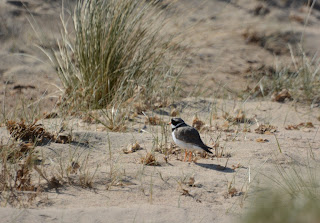
Ringed plover - it just wouldn't play the game and face the
camera!
Some of the team stayed on in Norfolk on Sunday evening for another mist netting setting at Gedney, but I had somewhere else to be, so I headed home, tired but happy after another great weekend with my friends at the Wash.

Tuesday, 2 April 2013

Easter Weekend…Part 1 - WeBS

This weekend started with a trip over to Nottingham to do my WeBS counts (yes I know, slightly belatedly). It was that nice a morning, I didn’t even need to wear a woolly hat! I arrived at Martin’s Pond in Wollaton slightly ahead of my friend and fellow WeBS counter, Mike, so I headed onto the site to wait for him and to play with my camera. I was duly greeted by a pair of swans who waddled over and proceeded to try to eat my jacket! They soon realised it wasn’t very tasty and went in search of something a little more nutritious.

Tufted duck at Martin's Pond

Pochard at Martin's Pond
As Mike and I wandered round counting the water birds, the birds in the trees above us were singing their little hearts out. Here’s hoping they know something the weather forecasters don’t and that spring really is on the way. The walk through Harrison’s Plantation to Raleigh Pond took slightly longer than usual as we were distracted by siskin, nuthatch and coal tit (amongst others). It was nice to see a few shoveler on Raleigh Pond too – not a usual suspect there!

Siskin in Harrison's Plantation
Fluffed up siskin - maybe the birds still
think it is pretty cold!
On to Wollaton Park… Now, I know that Attenborough likes to play host to all sorts of not exactly native species, but Wollaton Park was joining in the fun on Friday with a pair of Egyptian geese to go with the red-crested pochards and the ubiquitous Canada geese. They really are funny looking things! The lake had an unusually high number of swans on there too, but sadly, none of them were anything other than mutes. The recently formed heronry is up and running again this year with four birds sitting on nests (and a number of other seemingly empty nests in close proximity). One of the many Canada geese kindly showed off its colour ring to me, which was nice of it, and it appeared to be a bird I had not seen there before (at least I didn’t recognise the ring number, although I may yet be reminded that I have indeed seen it previously!).

On the way back around the lake we were treated to a very close view of a treecreeper, one of my favourite little birds! All in all, a very nice morning. Good to catch up with Mike, see some sunshine and have decent numbers of birds to count.

Monday, 25 February 2013

Sunday at Granby

So, after being ill for the first few weeks of the year, it was a delight to finally be able to get out ringing again this weekend. I joined Jim, Duncan, Emma and Dave at Granby for a chilly (well it wouldn’t be Granby if it wasn’t freezing) morning’s ringing at one of SNRG’s winter feeding sites.
 
It sounded pretty quiet as we were putting the nets up so we were not expecting a big catch. The first round provided about twenty birds which was a bonus. Subsequent rounds were steady, but provided fewer birds and we finished on seventy-four birds including a treecreeper, a brambling, a redwing, yellowhammers, great tits, blue tits, dunnocks, blackbirds, robins, chaffinches and a wren.
 
Oh and not forgetting my personal favourite, a very feisty, female green woodpecker. We had heard her laughing at us a few times during the morning from a little way off but hadn't seen her. Then all of sudden, Dave was up and running... He had seen a large bird flying into the net and thought it was a sparrowhawk, but when he got closer, it turned out to be this little beauty! This was a new species for me and I was lucky enough to be able to ring her. Her wing showed two different ages of feathers indicating that she had been born last year. It certainly made my morning!
 
Beautiful female green woodpecker
Green woodpecker wing showing two ages of feather
Thanks all for a great morning (and great to meet you Dave - thanks for running so quickly!).
 
Ruth

Sunday, 30 December 2012

Happy New Year...

I travelled over to Nottingham this morning to join Jim, Pete and Duncan at the Granby Fridge Experience. It was a beautiful sunny morning, but very cold and slightly breezy. The windy conditions seemed to be keeping most of the birds at bay so the catch was a small one consisting of mostly tits (nearly all adults), chaffinches, dunnocks and robins.

By mid-morning, the wind had increased in velocity (and bitterness) so we decided to take the nets down. As we headed to the nets, Pete suddenly launched into a sprint with the words ‘big bird’ trailing in his wake. At first I thought he had been spending too much time with the little ones and was having visions from Sesame Street, but when I couldn’t see a giant yellow bird anywhere, I realised he must have seen something bouncing in the nets! When he emerged from the nets a minute later he was holding a fabulous 5M (male bird, born last year) sparrowhawk which I was lucky enough to ring.

Me, my new friend and a silly hat!
For more photos and a full list of what we ringed, head over to the South Notts Ringing Group blog.

So, time to set a few New Year resolutions:

·        New Year’s Resolution #1: get the garden nets up more often.

·        New Year’s Resolution #2: get some traps set in the garden for when it is too windy for nets (which it invariably is).

·        New Year’s Resolution #3: get out with SNRG more often and ring more passerines.

·        New Year’s Resolution #4: make more bird bags when the weather is too rubbish for ringing full stop.

·        New Year’s Resolution #5: keep resolutions 1 – 4!!!

I hope 2013 is a birdtastic year for everyone.
 
Happy New Year!