Wednesday, 16 May 2012

Birding in the north-east

Last weekend Dave and I headed over to the north east coast to do a bit of birding (after a visit to the book fair at the SOC at Aberlady Bay). Saturday was a stunning day, if a little windy, with fantastic visibility so our first stop was North Berwick to gaze longingly at Bass Rock. The number of gannets on or flying around Bass Rock was simply breathtaking!


After an al fresco lunch, Dave suggested tootling down the coast to the National Trust for Scotland’s St Abbs Head National Nature Reserve. We parked at the visitor centre and took a walk along the cliffs to the lighthouse and back. The cliffs are home to an extensive breeding colony of razorbill, guillemot, kittiwake, fulmar, shag, herring gull, the occasional oystercatcher, jackdaw and so on.

How many species can you see?

Out to sea, strings of gannets were flying low over the waves, heading towards Bass Rock, and in the surrounding fields, wheatear and meadow pipits were plentiful. Halfway to the lighthouse, we heard whimbrel calling from somewhere very close by and turned round to see two feeding right behind us. Their call is a wonderfully evocative sound and to see and hear them so close was brilliant.


When we reached the lighthouse, we realised that the reason there hadn't seemed to be massive numbers of seabirds on the cliffs was because we hadn't reached the main colony yet. The cliffs at the lighthouse end were teaming with birds, including hundreds of kittiwakes, some of which were very close to where we were stood watching them. Some of the kittiwakes were already on eggs whilst many were still nest building. 


Kittiwake carrying nest material

As we drove away from St Abbs Head, we were treated to the sight of a roe deer buck walking casually across the road and jumping a pretty high fence with such grace and ease. It didn't seem at all bothered that we were there and even stopped to look at us for a few seconds before sauntering off across the field!


After staying the night with friends in Northumberland, we went out to Cresswell Pond and Druridge Bay on Sunday and then stopped for a look at Coquet Island (from the mainland). This area has a cracking coastline that is home to so many birds. To name but a few, we spent the morning looking at avocet on Cresswell Pond, red throated diver, common scoter, gannet and sandwich tern out at sea off Druridge Bay, turnstone and eider just offshore, oystercatacher, black tailed godwit, redshank, lapwing (amongst others) on the ponds at Druridge Bay and puffin and possibly roseate terns off Coquet Island. The area was buzzing with swifts, swallows and house martins and whitethroats were singing away in the scrub.


All in all, it was a cracking weekend. The weather, for once, stayed kind to us (other than the fierce wind which made it a little cold) and the birds were very obliging. Even Max enjoyed himself!


Sunday, 6 May 2012

Fifty up

Having become completely fed up with all the wind and rain that has been preventing me from putting my nets up recently, I was delighted to see a forecast saying it was going to be both dry and calm today.  When I woke up, the forecast was correct for once and I almost ran down to the garden to set the nets.

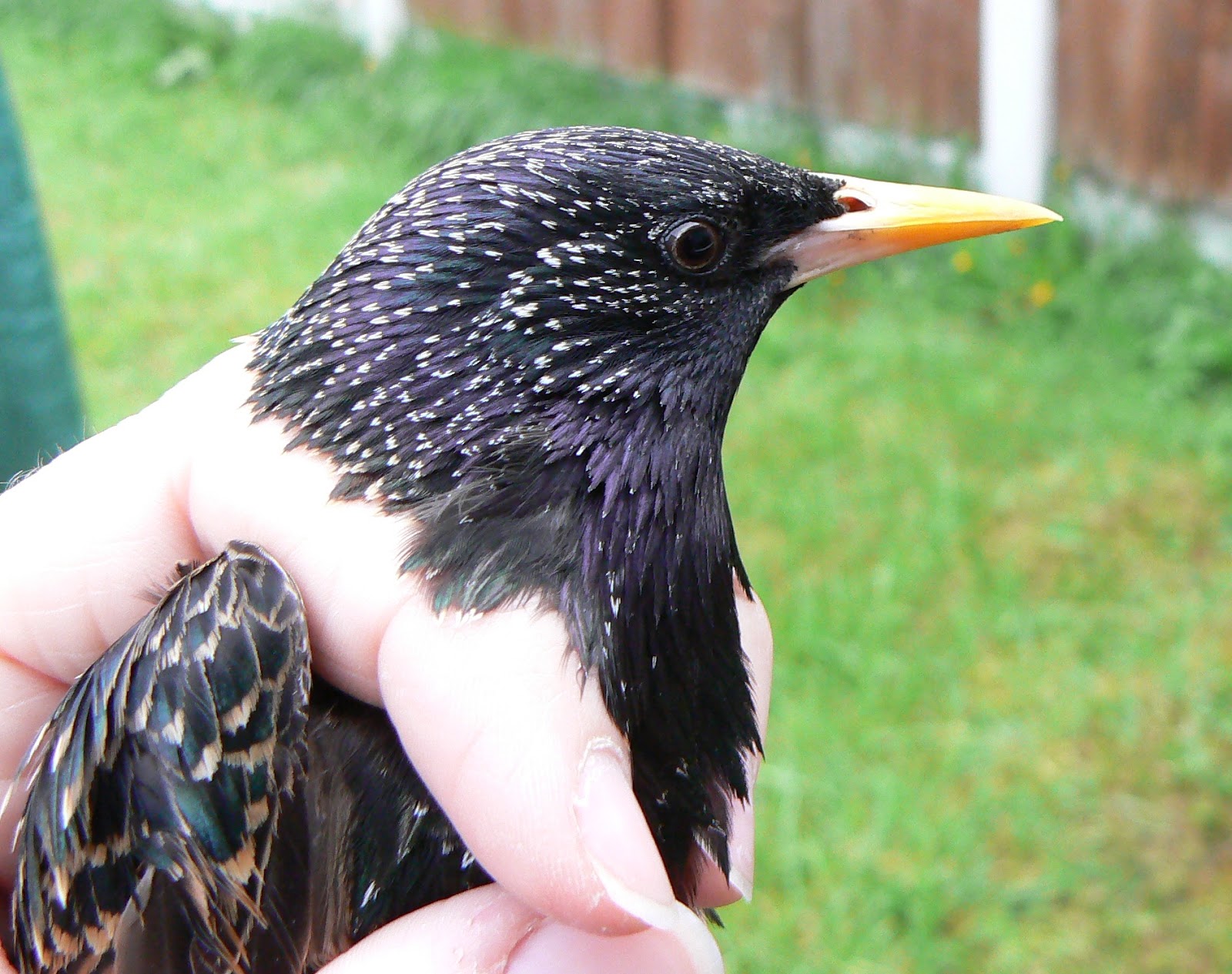
The catch started nicely with a chaffinch and a couple of dunnocks finding the nets quite quickly. One of the dunnocks was a re-trap from my first garden ringing session back in March. Its CP was a tad bigger than it had been back then! A gorgeous male starling jumped into the nets next and for once, I found this one quite easy to age as an adult.

Dunnock
'Spotless' adult male starling
Two house sparrows followed, with the female being bigger and quite considerably heavier than the male (and yes, I double checked the scales). The next bird into the net, an adult female blackbird, was the fiftieth bird processed in the garden. Out of those fifty, only five have been re-traps. I was hoping I might also break fifty birds ringed today but unfortunately, the sun decided to come out to play and bring its friend, the light breeze, with it.

Lucky number 50
A couple of hours later, having had no further birds, I was contemplating taking the nets down and digging out the lawnmower. Luckily, I listened to my intuition and left the nets up for a few more minutes. Just as well I did because within a minute or two, the sun and the breeze went to play hide and seek behind the clouds and my garden became blackbird central.

Three blackbirds and a robin later and the conditions changed once more and this time I did take the nets down. One of the blackbirds was a re-trap, therefore leaving me short by two for my fifty new birds ringed. I will just have to save that milestone for next time (which, judging by the weather forecast I have just seen, may be some time).

Oh, and note to self (and anyone else out there who is as unobservant as me when they are mowing the lawn) … lawnmowers and guy ropes don’t mix! Oh, and just in case you are wondering, guy ropes also don’t mix with strimmers!!!

Ruth

Sunday, 29 April 2012

Recent ringing exploits

So last weekend the weather looked as though it may play ball and allow me to get the nets up for a while on Saturday. I managed one hour before the rain started! And, in that hour, only two birds decided to pay the nets a visit. The first was an adult robin. For once, an easy one to age. The second bird was a female starling...not so easy to age! I ended up putting it down as a 4.


On Sunday I joined the South Notts Ringing Group for the last session at the Granby fridge experience - the details of which can be found on their blog here:  http://southnottsringinggroup.blogspot.co.uk/2012/04/granby-sunday-22-april.html

After this, we went to check some tawny owl boxes in the Newark area. It is wonderful to be able to see this species close up and we were lucky enough to find some ringable chicks and one beautiful unringed adult.

Sleepy mum
Chilled out baby tawny owl
No chance of any ringing this weekend due to the high winds and rain. Instead, on Saturday, I went over to Clifton Grove to try to see some of the 47 wheatears that had been reported there on Friday. Unfortunately, I only managed one! However, I did hear a cetti's warbler and see a marsh tit which made the visit worthwhile.

Now, anyone know where the stop cock is for the rain tap?

Ruth 

Tuesday, 10 April 2012

The Wash

I spent the Easter weekend at The Wash with the Wash Wader Ringing Group. Despite our very best efforts in setting the nets at three different locations on three different tides, the birds didn't want to play ball and we didn't manage to take a catch. Lots of other things were done though including colour ring re-sighting, data checking, kit maintenance and enjoying great company. We even managed a recovery when I found a dead sanderling on Heacham Beach with a ring on it. It had been ringed in October on Snettisham Beach so it hadn't moved very far!

Friday, 6 April 2012

Six birds, six species...

My garden may not generate large numbers of birds, but what I love about ringing in it is the variety it produces. This morning’s efforts saw only six birds fail to miss the nets (seven if you include the song thrush that escaped before it could be extracted…grrr!). One cheeky greenfinch even tried to land on the top shelf string but found it too unstable to hold his weight! Unfortunately, he flew off rather than fall into the nets.

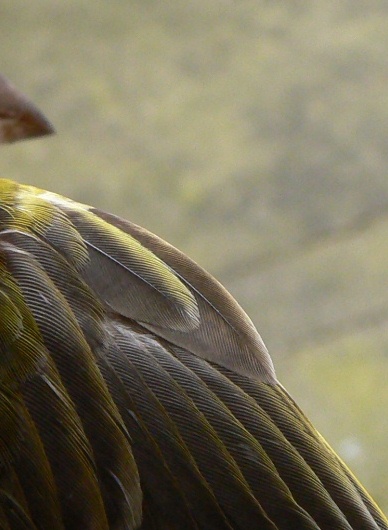
First up this morning was a first year robin, followed by a first year male goldfinch sporting worn primaries and tail feathers with many of the white tips abraded. The wing shows a clear colour contrast between the moulted greater coverts and the unmoulted outer-most greater covert, primary coverts and alula.

Red extending behind the eye and dark nose hairs = male
White tips abraded off primaries, 1 ogc, colour contrast between
moutled and unmoulted feathers
Abraded tail feathers
Next up was a male house sparrow. My back garden has had over 30 house sparrows in and around it in recent days and they are still slowly trickling into the nets. I have ringed twelve individuals (and re-trapped one of them) in the time (almost a month) that I have been ringing in the garden. Still a few to catch then!

The fourth bird into the nets was a new species for the garden – a reed bunting. The garden backs onto allotments and beyond that, arable fields so I was not too surprised to see a reed bunting in the nets. The slightly surprising thing for me with this bird was that it was still in winter plumage; I have seen so many male reed buntings recently that are already in their full summer finery.

I am afraid to say that I copped out of ageing this one. I was erring towards putting it down as an adult on the quality of the tertials and the condition of the primaries but I wasn’t convinced the tail was a full adult tail. Svensson mentions eye colour for this species (although I have never used that as a criteria before) and this one definitely had a brown rather than a grey iris (indicating adult) but I wasn’t sure enough to 6 it.


Reed bunting (from top) - male, winter plumage head pattern
(note brown iris), little wear on primaries, nice tertials and
(for me) an inconclusive tail shape.
The last two birds of the morning were a first year male great tit and a first year female blackbird with a large brood patch. When the morning became dull and overcast, the nets were much more productive. I know I wouldn’t be popular with the neighbours for wishing this but I do wish it was a little less sunny and breezy here on mornings when I want to put the nets up!

Full catch for the morning (all new birds) was: robin - 1, goldfinch – 1, house sparrow – 1, reed bunting – 1, great tit – 1, blackbird – 1.

Ruth

Sunday, 1 April 2012

Ringing with the Sorby Breck Ringing Group

This morning I joined Geoff Mawson and a few members of the Sorby Breck Ringing Group for their last visit to one of their feeding stations; Renishaw Park. It was a frosty start, with the windscreen requiring a scrape before I left home, but it soon warmed up and turned into a cracking morning.

Renishaw Hall and Gardens is a beautiful estate belonging to the Sitwell family and is a site that Geoff has been ringing at since 1968! The nets were set up around a feeding station in woodland (next to a lake) and in the formal gardens.

As I joined Geoff for an early net round, I could hear nuthatches calling. This is a species that I have never seen in the hand so I asked Geoff if they caught them there. Lo and behold, we got to the nets and there were two nuthatches waiting for us. Another bird was also caught at the other nets. All of the birds were re-traps so I didn’t have chance to ring one but it was fabulous just to process one and to learn the criteria for the plumage difference between the sexes. We were lucky enough to catch a male and two females so I was able to compare the deep chestnut colour of the male against the paler female. Gorgeous birds.

Nuthatch - one of my favourite birds!
The morning also generated my first chiffchaff of the year (again a re-trap) but it was great to see this migrant back in the UK and to hear them singing all morning. Some of the birds we caught had large amounts of pollen on their feathers (above and below the beak) causing the feathers to clump together. The first couple of spring blackcaps were caught too. We were all listening out for willow warbler, but none were heard.

Feathers covered in pollen - probably brought over from their
wintering grounds
Pollen under beak
Throughout the morning we had been treated to the sound of lesser spotted woodpecker calling and drumming. Unfortunately, we didn’t manage to catch one, but a pair did delight us by flying in to feed on a nearby tree. One then briefly flew to an alder sapling just six feet away from the ringing station! It was a fantastic privilege to be that close to such a beautiful and, sadly, uncommon bird. The park is believed to play host to three pairs.

The session was quite steady with a lot of re-traps, especially tits, and we finished on a very respectable 70 odd birds. I was made to feel very welcome by Geoff and the other ringers in the group and I extend my thanks to them for letting me join them. It is such a bonus to be able to gain experience with new birds and with different trainers / ringers and really good to be able to forge new links with another ringing group. I hope to be able to catch up with members of the group again in the future.

Ruth

Another slow morning

It is a rare thing for me to be at home, with nowhere that I need to be, on a Saturday morning. So, I decided to take full advantage and pop the nets up. It was a grey, miserable day that was trying its best to rain (and failing thankfully) so I thought I might have more luck with the nets.

Unfortunately, I was wrong and it turned out to be another slightly too windy and, therefore, quiet day. My first bird in the nets was a re-trap male great tit that I had caught on my first garden ringing session. Surprisingly, it weighed exactly the same weight as when I caught it two weeks ago. The birds trickled into the nets slowly and blue tit and a house sparrow followed. I then caught my 12th species for the garden so far, a blackbird.
 
 
A new chaffinch came next, followed by another house sparrow. The session ended with a pair of greenfinch and I am again, not convinced I have their ages correct. My previous greenfinches generated some differences of opinion, so I shall post a couple of pics of today’s pair on here to see what people think.
Female wing
Female alula
Female tail
Male wing
Male tail
A couple of starlings and another blackbird bounced out of the Jap net which, given the total catch was so low, was paticularly frustrating. Guess I’ll just have to save them for another day!

As the wind picked up I took the nets down with a final tally of 8 birds of 6 species (new/retrap): great tit 0/1, blue tit 1/0, house sparrow 2/0, blackbird 1/0, chaffinch 1/0, greenfinch 2/0.

Ruth